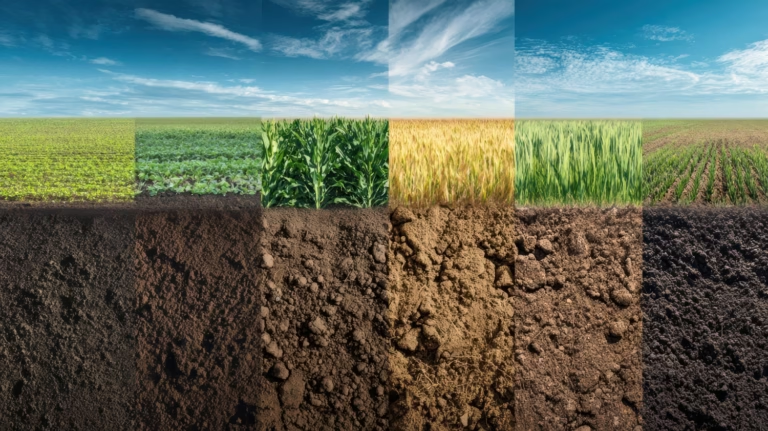

In the preceding article, we looked at the living world beneath our feet, the complex, teeming ecosystem that constitutes healthy soil and some ways in which that health is threatened. We examined how soil binds together the functions of the natural world: feeding plants, filtering water, storing carbon, and sustaining life across every scale from microorganism to civilization. We ended with a question that hangs over modern agriculture and land management alike: how do we sustain and restore the soils upon which we depend?
One of the most consequential answers humanity has reached for, especially over the past century, has been fertilizer. In its simplest sense, a fertilizer is any material added to soil to supply nutrients that plants require for growth. But fertilizers are far from simple. They exist in a vast spectrum of forms, organic and inorganic, slow-release and fast-acting, targeted and broad, and their relationship with soil health is nuanced, sometimes contradictory, and always consequential. Used wisely, fertilizers can dramatically improve food production and even support soil recovery. Used carelessly, they can accelerate the very degradation they are meant to reverse. We examine that relationship; what fertilizers are, why they are used, how different types interact with the soil ecosystem, and what the science and practice of responsible fertilizer use looks like for farmers, policymakers, and the planet.
Why Soils Need Nutrients and Why They Run Out
Every crop grown and harvested removes nutrients from the soil. When a farmer cultivates a field of maize, for instance, the growing plants draw nitrogen, phosphorus, potassium, and a suite of secondary and trace elements out of the soil through their roots. At harvest, those nutrients leave the field entirely, locked inside the grain, stalks, and leaves that are taken away. Left unmanaged, this continuous removal creates a steady depletion of the soil’s nutrient reserves.
In natural ecosystems, this loss is counterbalanced by continuous nutrient cycling. Dead plants and animals decompose, returning their nutrients to the soil. Nitrogen-fixing bacteria convert atmospheric nitrogen into soil-available forms. Mycorrhizal fungi extend the reach of plant roots, drawing in minerals from deep within the soil matrix. The system is self-renewing because its organic matter is never fully removed; it completes its cycle.
Agriculture breaks this cycle. It extracts nutrients from the land and exports them in the form of food, feed, and fiber, often to places far removed from the fields where those nutrients originated. Without some means of replenishment, even the most naturally fertile soil will eventually exhaust the nutrients it can supply to crops. The challenge, then, is not simply whether to replenish nutrients but how, in what form, at what rate, and with what broader effects on the soil ecosystem.
This is the problem fertilizers were developed to solve. And over the centuries, the solutions have evolved enormously, from the ancient practice of composting and manuring to the industrial-scale production of inorganic compounds that now secures much of global food production.
A Brief History of Fertilizer
Human beings have been amending soils for as long as they have been farming. Ancient Egyptians relied on the annual flooding of the Nile, which deposited fertile silt across their fields. Chinese farmers composted crop residues and applied human waste, known as “night soil” to their fields for millennia, maintaining remarkable soil fertility over generations. Indigenous farmers across the Americas incorporated fish into their planting holes alongside seeds, providing a slow-release nutrient source as the fish decomposed. In Europe, the spreading of animal manure was the cornerstone of traditional farming, integral to the rotation systems that sustained agriculture through the medieval period and beyond.
These practices worked because they returned organic matter and nutrients to the soil in forms that also nourished the microbial communities responsible for long-term fertility. They were, in modern language, regenerative. But they were also labor-intensive, limited in scale, and incapable of supporting the explosive growth in food demand that would accompany the Industrial Revolution and the rapid expansion of the global population.
The pivotal moment came in the early twentieth century with the invention of the Haber-Bosch process by German chemists Fritz Haber and Carl Bosch. This industrial method uses high pressure and temperature to convert atmospheric nitrogen, of which there is an almost unlimited supply in the air, into ammonia, the foundation of most inorganic nitrogen fertilizers. The implications were staggering. For the first time in human history, nitrogen-containing fertilizers could be manufactured at scale, decoupled from animal husbandry or organic matter, and applied to fields in concentrated form. The green revolution of the mid-twentieth century, which dramatically increased crop yields across Asia, Latin America, and beyond, was built largely on this foundation of synthetic fertilizers, along with improved seed varieties and expanded irrigation.
“The Haber-Bosch process is often credited with enabling the food production that sustains roughly half of all people alive today. It is one of the most consequential and most double-edged inventions in human history.”
Types of Fertilizers and How They Interact with Soil
Organic Fertilizers
Organic fertilizers are derived from natural sources, plant material, animal waste, food scraps, and other biological matter. This category includes farmyard manure, compost, green manures (crops grown specifically to be plowed back into the soil), bone meal, blood meal, fish emulsion, and many other products. Their defining characteristic is that they supply nutrients within a matrix of organic matter that also feeds the soil’s microbial communities.
When organic fertilizers are applied to soil, they do not immediately release their nutrients in plant-available form. Instead, they must first be broken down by soil microorganisms, bacteria, fungi, and invertebrates, through the process of decomposition. This takes time, but in doing so, it does something inorganic fertilizers cannot: it simultaneously feeds the soil biology, builds organic matter, improves soil structure, and enhances the soil’s capacity to hold water and resist erosion. In essence, organic fertilizers nourish the entire living soil ecosystem, not just the crops above it.
The limitation of organic fertilizers is their relatively low and variable nutrient content, combined with the difficulty of predicting precisely when and how quickly those nutrients will become available. A bag of inorganic nitrogen fertilizer guarantees a specific, measurable dose; a ton of compost offers a slower, more diffuse benefit that depends on temperature, moisture, soil biology, and the composition of the compost itself. For farmers managing large-scale operations under tight economic margins, this variability can be a significant challenge.
Inorganic Fertilizers
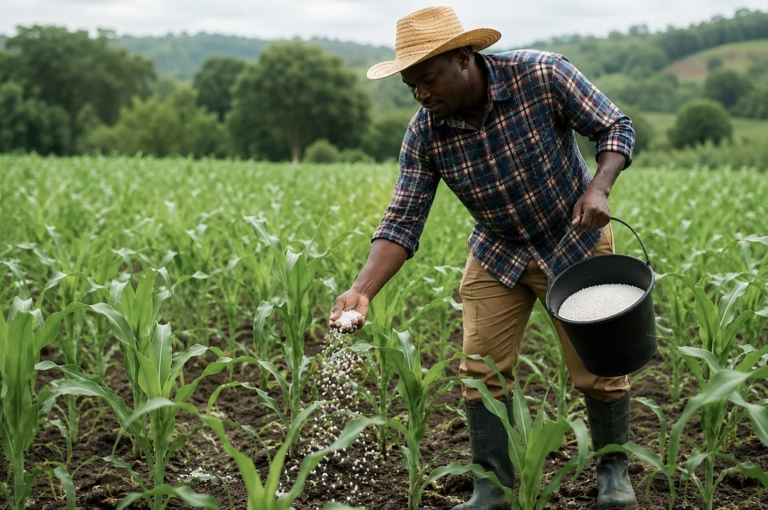
Synthetic fertilizers are manufactured chemical compounds that deliver specific nutrients, most commonly nitrogen, phosphorus, and potassium, in concentrated, readily available forms. The most widely used products include urea and ammonium nitrate (nitrogen), superphosphate (phosphorus), and potassium chloride or sulfate (potassium). These products are water-soluble, meaning that when applied to soil, they dissolve quickly and become immediately accessible to plant roots.
This immediacy is inorganic fertilizers’ greatest advantage. A field deficient in nitrogen can be visibly greened within days of application. Crop yields can be boosted substantially and predictably. The mathematical precision of inorganic fertilizer application — so many kilograms of nitrogen per hectare — appeals to the engineering mindset of industrial agriculture, offering control and reliability at scale.
But that same immediacy is also a significant vulnerability. Because inorganic or mineral nutrients are water-soluble and readily available, they are also highly mobile. When more is applied than the crop can absorb or when rainfall or irrigation washes the soil before uptake occurs, those nutrients leach downward through the soil profile into groundwater, or run off laterally into streams and rivers.
Biofertilizers
A third and increasingly important category consists of biofertilizers, products containing living microorganisms that, when applied to soil or seeds, enhance nutrient availability through biological activity. Rhizobium bacteria, for example, colonize the roots of leguminous plants such as soybeans, groundnuts, and clover, where they fix atmospheric nitrogen directly into plant-available forms. Mycorrhizal fungi form symbiotic associations with plant roots, dramatically extending their effective surface area and improving uptake of phosphorus and other minerals. Phosphate-solubilizing bacteria can unlock forms of phosphorus that are chemically bound in soil and otherwise inaccessible to plants.
Biofertilizers do not simply supplement nutrient supply; they restore and reinforce the biological systems that make soils naturally productive. They represent, in some respects, an attempt to re-establish what intensive farming has damaged: a living soil ecology in which nutrient cycling is driven by microbial partnerships rather than chemical inputs. Their role in sustainable agriculture is growing as research continues to identify and cultivate the microorganisms most beneficial to specific crops and soil types.
Fertilizers and the African Context
Nowhere is the complexity of fertilizer use more consequential or more misunderstood than in sub-Saharan Africa. The continent faces a seemingly contradictory challenge: soils that are simultaneously among the most nutrient-depleted in the world and yet chronically under-fertilized compared to global averages. While farmers in Europe or North America may over-apply fertilizers, most smallholder farmers in Africa apply too little, too infrequently, and often in the wrong form, contributing to persistent low yields on soils that are already exhausted.
The reasons for this under-application are largely economic. Inorganic fertilizers are not accessible to rural smallholders, who often lack access to credit, functioning markets, or reliable supply chains. A farmer who cannot afford to buy fertilizer, or who cannot get it to their field before the planting window closes, is effectively locked out of one of the most powerful tools for improving yields. The result is a vicious cycle: poor soils produce poor yields; poor yields generate insufficient income; insufficient income prevents investment in soil improvement.
Addressing this challenge requires more than simply increasing fertilizer supply. It requires developing fertilizer products and application strategies suited to African soil types and crop systems, building the rural infrastructure through which products and knowledge can reach farmers, and supporting locally adapted organic and biological approaches that reduce dependence on imported inputs. African heads of government, in the Abuja Declaration on Fertilizer for an African Green Revolution, have recognized this complexity and attempted to address it through a combination of policy reform, market development, and farmer education.
Getting It Right: Principles of Responsible Fertilizer Use
The question of how to use fertilizers responsibly in ways that support rather than undermine long-term soil health has occupied agronomists, ecologists, and farmers for decades. While no single prescription applies to all soils, climates, and cropping systems, a set of principles has emerged that is broadly applicable.
The first and most fundamental principle is soil testing before application. A fertilizer applied to a soil that is already adequately supplied with a given nutrient provides no benefit to the crop and causes only harm to the broader environment. Soil testing identifies specific deficiencies and allows fertilizer applications to be precisely targeted, matching supply to genuine demand. Despite being a simple and relatively inexpensive practice, soil testing remains underutilized in many farming systems, particularly in low-income regions where extension services are weak and laboratory infrastructure is limited.
The second principle is timing. Fertilizers are most effective and least harmful when applied at the moment when the crop most needs and can absorb them. Applying nitrogen fertilizer long before crops are actively growing, or immediately before a period of heavy rainfall, invites leaching and loss. Split applications; dividing the total fertilizer dose into smaller amounts applied at different crop growth stages improves uptake efficiency and reduces environmental loss. Modern precision agriculture technologies, including remote sensing and soil moisture monitoring, are making it increasingly possible to time and target applications with unprecedented accuracy.
The third principle is form. Not all fertilizers are equal for all purposes. Slow-release fertilizer formulations, in which nutrients are gradually made available over weeks or months through coatings or chemical transformations, more closely match the timing of crop nutrient demand than soluble products. Organic fertilizers and biofertilizers, as discussed earlier, provide nutritional benefits embedded within a broader contribution to soil biology. The most productive long-term approach for many farming systems is an integrated one, combining targeted synthetic applications with consistent organic matter inputs and biological soil management to maintain both the immediate nutrient supply that crops need and the living ecosystem that makes soils sustainably productive.
The fourth principle is restraint. More fertilizer is not always better. Beyond a certain point, the point of agronomic sufficiency, additional fertilizer generates diminishing returns for crops while generating increasing harm for soils, water, and the climate. Excess nitrogen, in particular, is a major source of nitrous oxide, a greenhouse gas many times more potent than carbon dioxide. Reducing fertilizer overuse in high-input agriculture is not merely an environmental gesture; it is economically rational and increasingly essential.
Toward a Future of Soil-Smart Fertilization
The history of fertilizer use is, in many ways, the history of humanity’s evolving relationship with the soil, from intuitive partnership to industrial conquest, and now, gradually, toward a more sophisticated and sustainable integration.
The path forward is a radical improvement and transformation. It means investing in precision tools that put fertilizer exactly where and when it is needed. It means redesigning farming systems around soil health rather than around maximum short-term output. And it means ensuring that farmers in the most soil-depleted parts of Africa, where food security is most fragile, and the potential gains from better soil management are greatest, have access to the knowledge, products, and support they need.
Soil, as we explored in the first part of this series, is not merely a growing medium. It is a living system with its own ecology, its own rhythms, and its own requirements for care. Fertilizers, at their best, are one of the tools through which we meet those requirements.