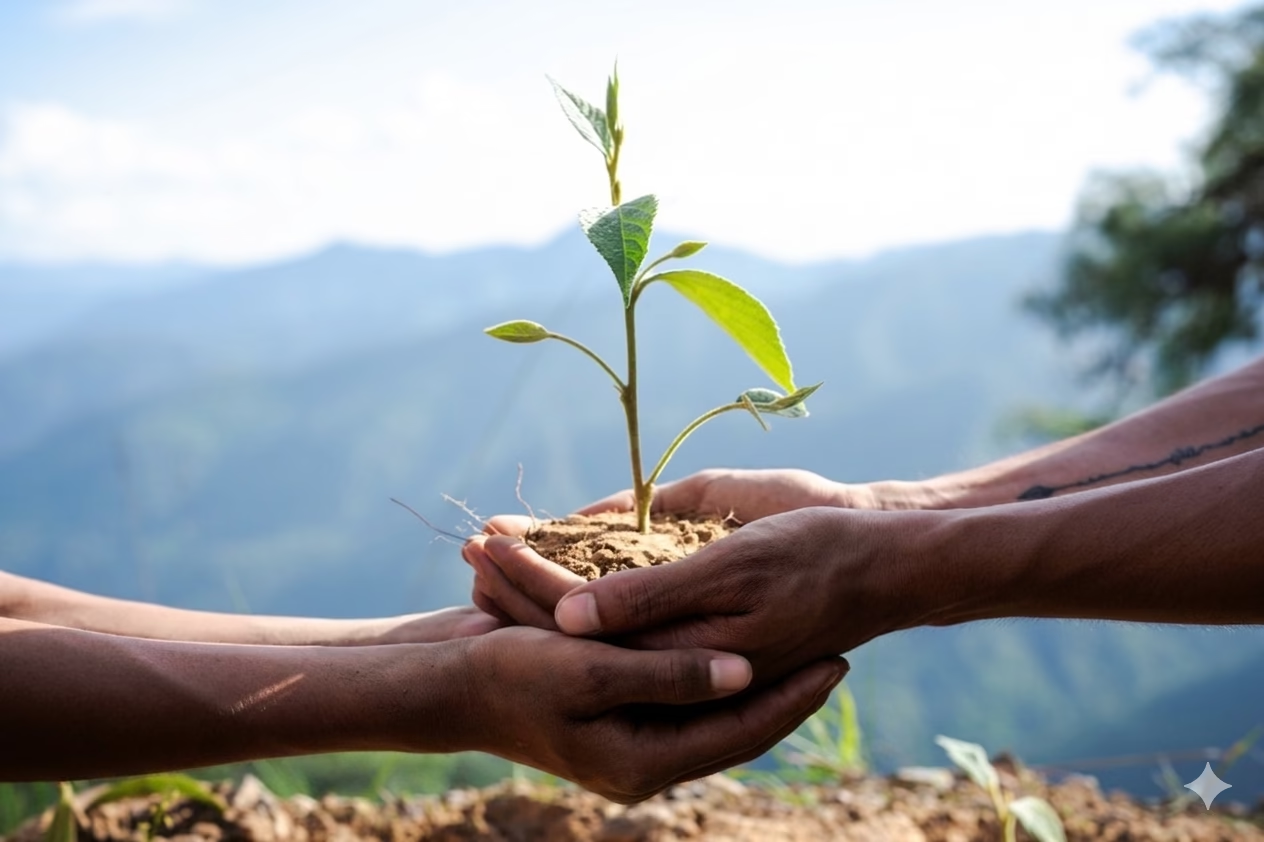

Applying the right nutrient source, at the right rate, at the right time, and in the right place is not merely agronomic best practice — for Africa’s smallholder farmers, it is the difference between a harvest and a loss.
| ~22 kg/ha Average fertilizer use in Africa — vs a global average 7× higher | 75–80% of Africa’s cultivated land is reportedly degraded | $4 bn+ in soil nutrients lost annually across sub-Saharan Africa |
Africa’s Soil Crisis Demands a Smarter Response
Sub-Saharan Africa stands at a critical agricultural crossroads. Its soils, the foundation of a food system that must sustain a population projected to reach 2.54 billion by 2050, are under severe and worsening stress. Between 75 and 80 percent of the continent’s cultivated land is reportedly degraded, with annual soil nutrient losses estimated at 30 to 60 kilograms per hectare. The economic toll exceeds USD 4 billion in lost soil nutrients each year, falling disproportionately on the smallholder farming households who have the least capacity to absorb it.
The policy response has grown in ambition. The 2024 Africa Fertilizer and Soil Health Summit in Nairobi, convened under the African Union, produced the Nairobi Declaration, a commitment to delivering crop- and site-specific agronomic recommendations to the majority of African smallholder farmers by 2034. The African Fertilizer and Soil Health Action Plan (2024–2034) sets out the roadmap. Yet translating political commitment into farm-level change requires a structured agronomic framework. That framework is the 4R Nutrient Stewardship approach.
What the 4R Framework Is and Why It Matters
Developed by the global fertilizer industry and championed in Africa by the African Plant Nutrition Institute (APNI), the 4R framework is built on a deceptively simple principle: nutrient management decisions must be guided by four interconnected criteria. The nutrient must be the Right Source, applied at the Right Rate, at the Right Time, and in the Right Place. Together, these four principles define what responsible, efficient, and sustainable fertilizer use looks like in practice.
The framework is not prescriptive. Its power lies in its adaptability: the 4Rs provide a universal structure that must be filled with locally specific agronomic knowledge. What constitutes the right source in the maize-dominated highlands of Kenya differs from what is right for sorghum in the Sahel or cocoa systems in Côte d’Ivoire. This is precisely why the 4R approach resonates so strongly with commitment to context-specific, science-based solutions for African agriculture.
The Four Rs in the African Context
| 01 Right Source | Match the fertilizer type, nitrogen, phosphorus, potassium, or micronutrients, to the specific nutrient requirements of the crop and the existing soil chemistry. In Africa, where soils vary dramatically across even small distances, this requires soil testing and locally validated product blends, including blended NPK formulations adapted to regional crop systems. |
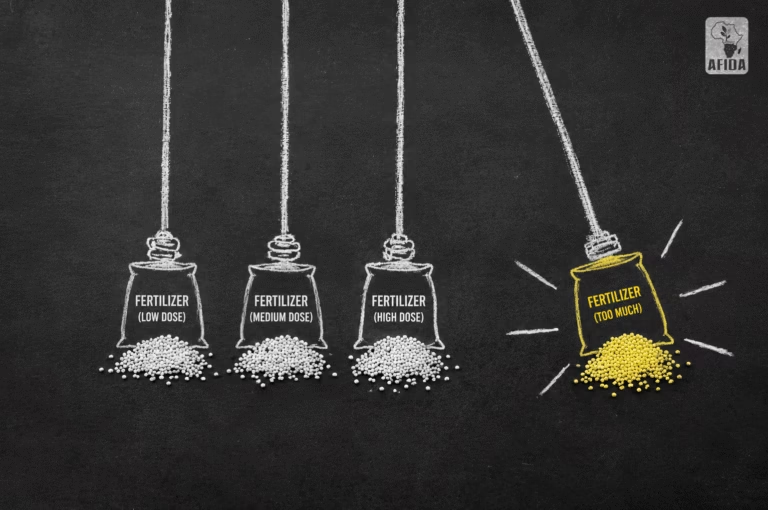
| 02 Right Rate | Apply the quantity that matches the crop’s nutrient demand, accounting for what the soil already supplies. Blanket fertilizer recommendations remain common across much of sub-Saharan Africa. Site-specific rate adjustments, informed by soil tests, yield targets, and economic return analysis, can prevent both the waste of over-application and the productivity loss of under-application. |
| 03 Right Time | Synchronize nutrient availability with the crop’s peak uptake windows. Split applications aligned with growth stages, particularly for nitrogen, reduce losses to leaching, volatilization, and runoff, which are especially pronounced in the high-rainfall environments of Central and West Africa and in the flash-rain patterns of the Sahel. |
| 04 Right Place | Position nutrients where roots can access them most efficiently. Deep placement and micro-dosing techniques, placing small amounts of fertilizer directly at the root zone, have demonstrated strong yield responses in semi-arid smallholder systems in the Sahel and East Africa, improving both agronomic efficiency and economic return per kilogram of input. |
“In Zambia, average maize yields sit at 1–2 tonnes per hectare. The agronomic potential is 9 tonnes.” – Gatti et al, 2023
That gap is not a soil problem alone; it is a knowledge and management problem the 4Rs are built to solve.
The Science Behind the Framework
Research across the continent consistently validates the 4R principles. A 2025 Frontiers in Agronomy study found that fertilizer use in sub-Saharan Africa remains around 20 kilograms per hectare, and that increasing it intelligently, with appropriate timing and placement, could boost overall maize supply by 20 percent in food-insecure maize-growing households. In Tanzania and Uganda, the potential gains are even higher. Studies on soybean production in sub-Saharan Africa showed that targeted phosphorus application of 21 to 30 kilograms per hectare could increase yields by approximately 48 percent.
On the placement dimension, micro-dosing and localized nutrient application techniques have proven their value for smallholder farmers with limited financial resources, improving both agronomic efficiency and water use. The Western Kenya 4R pilot project field-based learning centres supported by the fertilizer industry, radio programs, and ICT platforms demonstrated that even modest, well-targeted fertilizer use produces strong yield responses and offers a scalable model for the rest of sub-Saharan Africa.
The evolution of the framework has also gained traction at the continental level. The ECOWAS Regional Hub for Fertilizer and Soil Health, launched in 2024, explicitly anchors its site-specific recommendation systems in both the 4R principles and Integrated Soil Fertility Management (ISFM). IITA is deploying AI-driven modelling to generate location-specific 4R recommendations for West Africa at scale, precisely the kind of digital infrastructure that can bring the framework to smallholder farmers who currently have no access to agronomic advice.
Barriers to Adoption and How to Overcome Them
Despite its scientific robustness, 4R adoption across Africa faces real structural barriers, including the following:
- Limited soil testing infrastructure: Without access to soil testing services, farmers cannot determine the right source or rate. Expanding affordable, accessible laboratory networks and mobile diagnostic tools is a prerequisite.
- Weak extension systems: The withdrawal of public extension services in the 1980s and 1990s created a knowledge vacuum that has never been fully restored. Agro-dealers, often the primary point of agricultural advice for smallholder farmers, must themselves be trained in 4R principles to pass that knowledge on.
- Blanket recommendations: Many fertilizer supply channels, including subsidy programs, distribute standardized blends that do not reflect the highly heterogeneous soils across sub-Saharan Africa. Moving from blanket to site-specific approaches is both agronomically and economically justified, but requires political will and investment in data systems.
- Access and affordability: Precision fertilizer use requires access to the right products, not just knowledge. Supply chain gaps and high input costs remain significant constraints, particularly in remote smallholder farming communities.
- Climate variability: Increasingly erratic rainfall patterns in the Sahel and East Africa complicate the timing of nutrient applications. Adaptive 4R guidance, sensitive to seasonal forecasts, is an emerging frontier that the industry must actively invest in.
AFIDA’s Role in Scaling 4R Stewardship
AFIDA’s Capacity Building and Stewardship pillar is the industry vehicle for translating the 4R framework from concept to farm-level practice. Through the Sustainable Fertilizer Academy (SFA), a continent-wide partnership with the International Fertilizer Association (IFA), AFIDA is training the next generation of agricultural professionals: students, extension workers, and researchers who will carry 4R knowledge into the field.
The organization also advocates for enabling policy environments without which even the best agronomic frameworks cannot scale. Smart subsidies tied to targeted, soil-appropriate products rather than blanket blends; investment in digital infrastructure for site-specific recommendation delivery; and research partnerships that translate 4R science into locally validated protocols; these are the policy levers AFIDA presses for in its engagements with governments and continental bodies.
The AfricaFertilizer data platform further strengthens the information infrastructure on which 4R adoption depends. Transparent, granular fertilizer market and agronomic data, available at national, regional, and continental scales, is the backbone of evidence-based nutrient management policy.
Africa’s agricultural transformation does not depend only on matching fertilizer use levels in other regions. It depends on using fertilizer more effectively than anywhere else in the world.
Looking Ahead: From Framework to Food Security
The 4R framework is not a silver bullet. It must sit within a broader system that includes improved seed varieties, water management, organic input integration, and functioning agricultural markets. But it provides the most operationally clear and scientifically grounded entry point for transforming African fertilizer use from a blunt instrument into a precision tool.
The African Union’s 2034 target, site-specific recommendations for the majority of smallholder farmers, is ambitious. Achieving it will require deploying AI and data science at scale, rebuilding extension systems, reforming subsidy architecture, and training a new generation of agronomists in 4R principles. Each of these is a significant undertaking. Together, they represent the agricultural transformation pathway that Africa’s food security demands.
AFIDA is committed to advancing each of these fronts through industry engagement, policy advocacy, capacity building, and the partnerships that give the 4R framework the reach and impact it requires.
| AFIDA’s Call: The 4R Nutrient Stewardship framework represents the industry’s most important tool for turning fertilizer investment into food security outcomes. AFIDA calls on governments, development partners, and the private sector to embed 4R principles in every subsidy design, every extension programme, and every soil health investment made across the continent. The science is clear. The framework is ready. What Africa needs now is coordinated, sustained action. |
References: African Union Nairobi Declaration (2024); AUDA-NEPAD African Fertilizer and Soil Health Action Plan 2024–2034; CGIAR Regional Hub for Fertilizer and Soil Health (2024); APNI 4R Nutrient Stewardship Programme; Frontiers in Agronomy (2025); IFDC Fertilizer Use is a Climate Strategy (2025); Growing Africa Journal — ISFM and Precision Agriculture editions (2024–2025); Is closing the agricultural yield gap a “risky” endeavor? — Agricultural Systems Vol. 208 (2023)