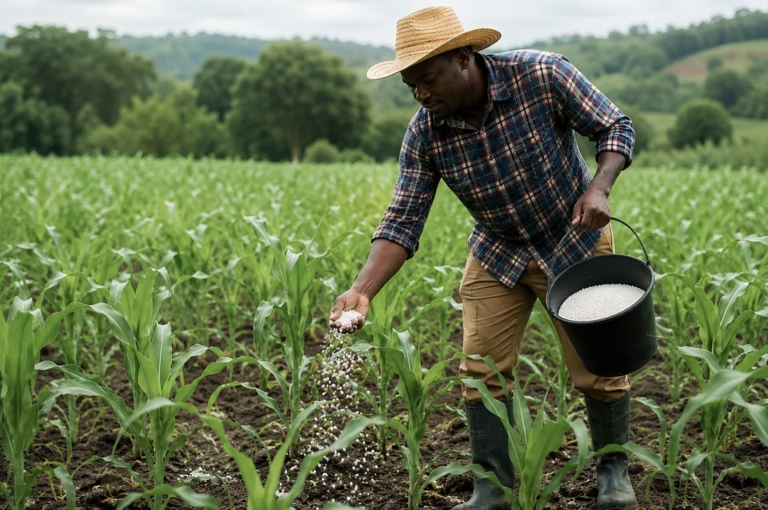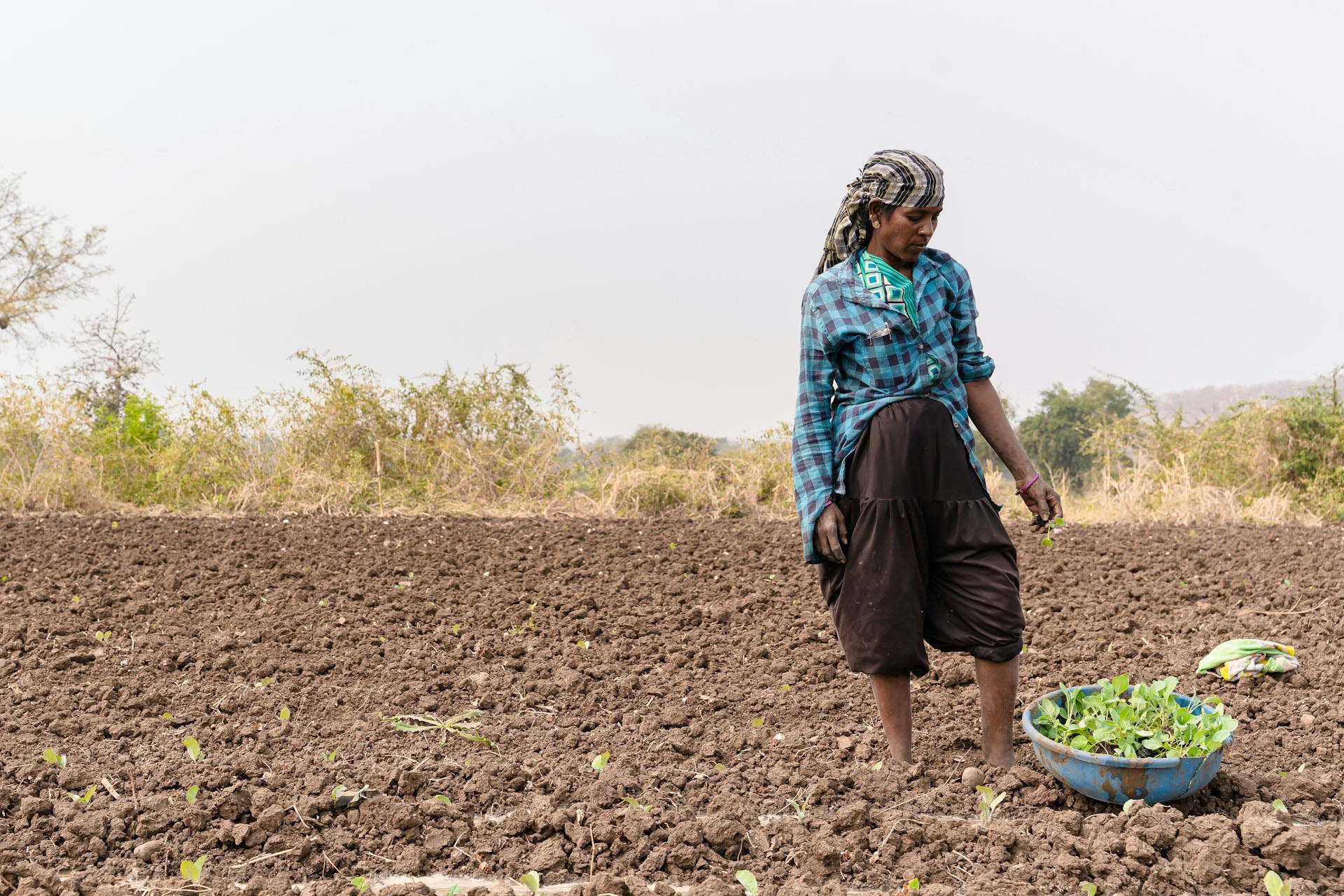

In a village, Mama Amina remembers two very different harvests. The first was in 2008, when the rains came late, and her maize barely reached her waist. The depot that usually supplied fertilizer had run empty weeks before planting season, and without nutrients to nourish the tired soil, her half-hectare yielded just enough to feed her family through the dry season—with nothing left to sell at market.
The second harvest she recalls vividly was three years later. A private fertilizer dealer had opened a shop in the neighboring town, stocking different blends throughout the year. Amina purchased a bag of NPK on credit, applying it as advised by the company’s agronomist, who visited monthly. That season, despite similar rainfall, her maize grew tall and strong. She filled twelve bags instead of three, sold eight at the market, and used the profit to send her youngest daughter to secondary school.
Mama Amina’s story is echoed across the African continent, from the maize fields of Kenya to the cocoa farms of Ghana, from the wheat plains of Ethiopia to the vegetable gardens of South Africa. It illustrates a fundamental truth: access to quality fertilizers at the right time can mean the difference between hunger and abundance, between subsistence and prosperity.
This is the story of how private fertilizer companies have become silent partners in Africa’s agricultural transformation, driving food security and resilience in ways that extend far beyond the chemistry of nitrogen, phosphorus, and potassium.
The Foundation of Modern Agriculture
Just as an iroko tree cannot grow strong without deep roots drawing nutrients from the soil, crops cannot thrive without replenishing what they take from the earth. Fertilizers are the backbone of contemporary farming, replenishing essential nutrients that crops extract during growth and enabling farmers to achieve yields that would be impossible through traditional methods alone.
In Africa, where soils have been depleted by decades of intensive use without adequate replenishment, fertilizers have become particularly crucial. The red soils of East Africa, the sandy terrains of the Sahel, and the acidic grounds of the Congo Basin each require specific nutrient interventions to unlock their productive potential.
Private fertilizer companies have revolutionized this sector by investing heavily in research, production capacity, and distribution networks. Unlike fragmented or government-controlled systems that often suffer from delays, shortages, and inefficiencies, these companies bring responsiveness to market demands that directly impact food availability on African tables.
Innovation Tailored to African Realities
One of the most significant contributions of private fertilizer companies to food security lies in their commitment to innovation that addresses Africa’s unique agricultural challenges. These organizations invest substantially in developing products suited to the continent’s diverse climates, soil types, and farming systems.
Consider the development of blended fertilizers specifically formulated for tropical soils, which tend to be acidic and deficient in phosphorus. Companies have created products that not only provide essential nutrients but also help correct soil pH, enabling better nutrient uptake. For cassava farmers in West Africa, rice growers in Madagascar, or tea producers in the Kenyan highlands, these targeted formulations make a tangible difference in productivity.
Recent innovations include controlled-release fertilizers that work with Africa’s unpredictable rainfall patterns, reducing nutrient loss during heavy rains or drought periods. Bio-fertilizers that incorporate beneficial microorganisms are being adapted to local conditions, helping farmers build soil health while reducing dependence on synthetic inputs—a particularly important development for organic farmers and those transitioning to sustainable practices.
Private companies are also pioneering fortified fertilizers that address micronutrient deficiencies common in African soils. Products enriched with zinc, boron, or sulfur help combat hidden hunger and improve crop nutritional quality, meaning the food grown doesn’t just fill stomachs but nourishes bodies.
Bridging the Last Mile
Perhaps nowhere is the impact of private fertilizer companies more visible than in overcoming Africa’s infamous “last mile” challenge. In a continent where low logistics satisfaction, limited infrastructure, and vast distances separate rural farmers from urban supply centers, getting inputs to those who need them is often the greatest obstacle to agricultural development.
Private companies have tackled this challenge with entrepreneurial creativity. They establish networks of agro-dealers in rural towns and villages, train local entrepreneurs to become distribution points, and invest in warehouses and storage facilities closer to farming communities. In countries like Tanzania, Zambia, and Côte d’Ivoire, private sector investment has multiplied the number of fertilizer retail points, reducing the distance farmers must travel from dozens of kilometers to just a few.
Many companies go beyond mere product distribution. They offer agronomic extension services, train farmers on proper application techniques, provide soil testing services, and create demonstration plots where farmers can see results firsthand. This integrated approach—combining product access with knowledge transfer—has proven particularly effective in raising productivity among smallholder farmers who constitute over 70% of Africa’s agricultural workforce.
Mobile technology has further enhanced reach. Companies partner with telecommunications providers to offer mobile-based ordering, credit systems, and agronomic advice via SMS. Farmers in remote areas can now order fertilizers from their phones and receive delivery at designated collection points, while also accessing information on weather forecasts, market prices, and best practices.
Economic Empowerment and Market Dynamics
The entrance of private fertilizer companies into African markets has created competition that benefits farmers through improved pricing, product variety, and service quality. In countries where government monopolies once dictated availability and cost, competitive markets have given farmers choices and negotiating power.
This competition drives innovation not just in products but in business models. Recognizing that many smallholders cannot afford to purchase inputs upfront, companies have developed flexible credit arrangements, often in partnership with banks, microfinance institutions, or farmer cooperatives. Input credit tied to output marketing—where farmers repay fertilizer loans after harvest through produce sales—has enabled thousands of resource-poor farmers to access nutrients they otherwise couldn’t afford.
The economic ripple effects extend throughout rural communities. Fertilizer companies create employment for warehouse managers, truck drivers, agro-dealers, and agronomists. They stimulate demand for related services like soil testing laboratories and agricultural equipment suppliers. When farmers achieve better yields thanks to adequate fertilization, they have more income to spend in local economies—on school fees, healthcare, home improvements, and other goods—creating prosperity that extends far beyond the farm gate.
For national economies, a vibrant fertilizer sector contributes to food self-sufficiency, reduces import dependence for staple foods, and can even create export opportunities. When Nigeria’s rice farmers increased production through improved fertilizer use, the country reduced rice imports by millions of tons. When Ethiopia’s wheat farmers boosted yields, the nation decreased its reliance on food aid.
Addressing Africa’s Sustainability Imperative
The conversation around fertilizers in Africa must balance productivity needs with environmental stewardship. The continent faces the dual challenge of feeding rapidly growing populations while preserving natural resources and adapting to climate change. Private fertilizer companies are increasingly recognizing their role in this balancing act.
Leading companies are investing in technologies and practices that improve nutrient use efficiency, meaning crops absorb more of what’s applied and less is lost to the environment. Precision agriculture tools, once available only in developed countries, are being adapted for African conditions. Handheld soil testing devices, drone-based crop monitoring, and GPS-enabled variable rate applicators are gradually becoming accessible, helping farmers apply the right amount of fertilizer in the right place at the right time.
Many companies are also promoting integrated soil fertility management, which combines mineral fertilizers with organic inputs like compost and crop residues. This approach, particularly relevant for African farmers who often have access to organic materials, builds long-term soil health while optimizing the use of purchased inputs.
Environmental responsibility also means addressing the carbon footprint of fertilizer production. Several companies operating in or serving African markets have committed to reducing emissions through renewable energy adoption in manufacturing, investing in green ammonia production technologies, and improving logistics efficiency to reduce transportation-related emissions.
Resilience in Times of Crisis
The COVID-19 pandemic and recent global supply chain disruptions revealed both vulnerabilities and strengths in Africa’s fertilizer systems. When international borders closed and global supply chains froze in 2020, many African countries faced potential fertilizer shortages that threatened food security.
Private companies demonstrated remarkable adaptability during this crisis. Those with regional production facilities ramped up output to compensate for import difficulties. Distribution networks quickly adapted to movement restrictions, establishing new delivery protocols and partnering with local authorities to ensure inputs reached farmers despite lockdowns. Companies with diverse supply sources could pivot when certain trade routes became unreliable.
This resilience contrasted sharply with government-managed systems in some countries, which struggled with bureaucratic delays and inflexible procurement processes. The experience reinforced the value of having a robust private sector as part of a diversified approach to agricultural input supply.
The 2022 global fertilizer crisis, triggered by the Russia-Ukraine conflict, further tested the system. Private companies worked to secure alternative supplies, explored local production possibilities, and helped governments and development partners design subsidy programs to cushion farmers from price spikes. While challenges remained, the private sector’s problem-solving capacity and market connections proved invaluable.
The Path Forward: Partnership for Agricultural Transformation
As Africa works toward feeding its projected population of 2.5 billion by 2050, private fertilizer companies will remain essential partners in the continent’s agricultural transformation. However, realizing their full potential requires a collaborative ecosystem involving governments, development organizations, research institutions, and farming communities.
Governments must create enabling policy environments that encourage private investment while protecting public interests. This includes streamlining import and distribution regulations, ensuring quality standards are maintained, supporting infrastructure development, and designing smart subsidy programs that leverage private sector efficiency rather than crowding it out.
Private companies, for their part, must prioritize long-term sustainability over short-term profits, invest in technologies that reduce environmental footprints, and ensure products remain accessible to smallholder farmers who need them most. Transparency in operations, adherence to environmental and social standards, and active engagement with farming communities will build the trust necessary for lasting partnerships.
Development partners and research institutions can facilitate connections between companies and farmers, support innovation through research funding, and help design programs that combine private sector efficiency with public development goals. Initiatives like the African Fertilizer and Agribusiness Partnership exemplify this collaborative approach.
Farmer organizations also play a crucial role by aggregating demand, negotiating better terms for their members, and providing feedback that helps companies develop more appropriate products and services. The growth of farmer cooperatives and associations across Africa strengthens the bargaining position of smallholders in fertilizer markets.
A Vision of Abundance
Return to Mama Amina’s village, and you’ll find a transformation underway. The private fertilizer shop that opened over a decade ago now employs three local youth and serves farmers from five surrounding villages. Amina herself has expanded her farm to two hectares and diversified into vegetables during the dry season using irrigation and appropriate fertilizers. Her daughter, whose school fees were paid from that bountiful harvest years ago, is now studying agronomy at university.
This is not an isolated success story. Across the African continent, where private fertilizer companies operate effectively within supportive policy environments and work in genuine partnership with farming communities, agricultural productivity is rising, food security is improving, and rural prosperity is growing.
The challenges ahead are significant—climate change, soil degradation, population pressure, and market volatility will continue to test agricultural systems. But with private fertilizer companies as committed partners in Africa’s development, bringing innovation, investment, and infrastructure to support millions of farmers, the continent moves closer to a future where no child goes to bed hungry, where farmers prosper from their labor, and where African agriculture feeds not just the continent but contributes to global food security.
The story of food security in Africa is still being written, and private fertilizer companies hold an important pen. Their role in driving agricultural growth and resilience will help determine whether the continent realizes its potential as a global breadbasket or continues to struggle with food deficits. The choice before us is clear: embrace effective partnerships that combine private sector dynamism with public purpose, and cultivate an African agricultural renaissance that nourishes bodies, builds economies, and sustains the land for generations to come.