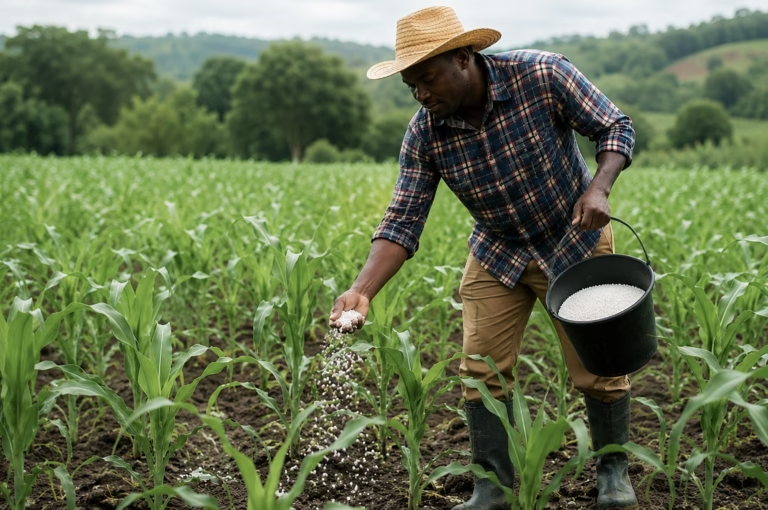

Africa feeds 17% of the world’s population, but uses only 3% of global fertilizer. This stark disparity lies at the heart of one of the continent’s most pressing challenges: the yawning gap between what African farmers currently produce and what their land could yield.
While farmers in Asia apply an average of 150 kilograms of fertilizer per hectare and those in Europe use over 120 kg/ha, African farmers use barely 20 kg/ha. The result? Crop yields that hover at a fraction of their potential, persistent food insecurity, and missed opportunities for economic transformation.
The Mathematics of Hunger
The numbers tell a sobering story. Across sub-Saharan Africa, maize yields average about 2 tons per hectare, compared with roughly 10 tons per hectare in the United States and around 6 tons per hectare in China, according to data from the FAO and the USDA. Rice production shows a similar pattern: African farmers harvest approximately 2.5 tons per hectare, while farmers across Asia regularly achieve over 5 tons per hectare on comparable land.
This yield gap translates directly into food insecurity. Over 280 million Africans face chronic hunger, and the continent paradoxically imports over $35 billion worth of food annually despite having 60% of the world’s uncultivated arable land.
The primary culprit? Soil nutrient depletion. Decades of continuous cropping without adequate fertilizer application have left African soils depleted of essential nutrients like nitrogen, phosphorus, and potassium. Studies show that African soils lose an estimated 30 kilograms of nutrients per hectare annually, yet farmers replace only a fraction of this through fertilizer use.
Why Fertilizer Remains Out of Reach
The barriers preventing African farmers from accessing fertilizer extend far beyond simple affordability, creating a complex web of challenges that keep productivity stubbornly low.
Physical unavailability: In many rural areas, fertilizer simply isn’t available for purchase at any price. A farmer in remote Ethiopia or northern Mali might need to travel 50-100 kilometers to find a retailer stocking fertilizer, a journey that can take an entire day and cost money most farmers don’t have. During peak planting seasons, even available stocks sell out quickly, leaving late arrivals empty-handed. Across rural Africa, an estimated 40% of farmers report that fertilizer is unavailable in their local markets during critical planting windows.
Policy and regulatory barriers: High import tariffs, inconsistent subsidy programs, and bureaucratic red tape further constrain access. Some countries maintain state monopolies on fertilizer importation, limiting competition and innovation in the sector. Subsidies that shift unpredictably from year to year prevent farmers from planning long-term investments and discourage private sector development of distribution networks.
Timing mismatches: Even when fertilizer is available, it often arrives at the wrong time. Supply chains oriented around urban markets and export agriculture frequently deliver fertilizer to rural areas weeks or months after farmers need to plant. A farmer who receives fertilizer in July when planting should have happened in May faces a painful choice: use it ineffectively on late-planted crops or store it for next season, tying up scarce capital for months.
Prohibitive costs: Yes, price matters enormously. A 50-kilogram bag of NPK fertilizer that costs $25 in parts of Asia can run upwards of $60-80 in rural Africa. When your entire annual income hovers around $1,000-2,000, purchasing adequate fertilizer becomes an impossible choice between feeding your family today and investing in tomorrow’s harvest. Infrastructure deficits mean that transporting fertilizer from ports to remote farming communities can double or triple the final cost. In landlocked countries like Malawi or Ethiopia, transport costs alone can account for 50-70% of the retail price.
Knowledge gaps: Many farmers lack information about which fertilizer types to use, how much to apply, and when to apply it. Without this knowledge, even farmers who can access fertilizer may use it incorrectly, applying the wrong nutrient blend for their soil type, using insufficient quantities to make a difference, or applying at the wrong growth stages. In surveys across Ghana and Tanzania, over 60% of farmers reported they had never received training on proper fertilizer use, and many couldn’t distinguish between different fertilizer formulations.
Counterfeit and substandard products: The fertilizer market in many African countries is plagued by fake and adulterated products. Unscrupulous traders mix fertilizer with sand, salt, or cheaper compounds, selling ineffective products at full price. Farmers who unknowingly purchase these counterfeits see minimal yield improvements and lose faith in fertilizer altogether. In Nigeria, studies suggest that 20-30% of fertilizer sold in some markets is counterfeit or significantly below stated nutrient content.
Lack of complementary inputs: Fertilizer works best when combined with improved seeds, adequate water, and pest management. Farmers who can’t access these complementary inputs see diminished returns from fertilizer alone, making the investment seem less worthwhile. A farmer using local seed varieties may see only modest yield improvements even with fertilizer, while a neighbor with hybrid seeds might triple their harvest with the same fertilizer application.
Gender barriers: Women farmers, who produce 60-80% of Africa’s food, face additional obstacles. Cultural norms in many communities restrict women’s access to land ownership, credit, and agricultural inputs. Women often can’t attend training sessions held far from home, can’t travel to distant markets to purchase fertilizer, and may lack control over household finances needed to invest in inputs. In Malawi, studies found that women farmers use 30% less fertilizer than men farming similar-sized plots, primarily due to access barriers rather than choice.
Risk aversion and past disappointments: Many farmers remain skeptical of fertilizer after past negative experiences, perhaps they purchased fertilizer on credit, experienced crop failure due to drought, and couldn’t repay loans. Others witnessed neighbors who used fertilizer but saw crops destroyed by pests or disease, suffering losses despite the investment. This rational risk aversion keeps fertilizer adoption low even when access improves.
The Ripple Effects of Better Nutrition
When soils receive adequate nutrients, the impacts cascade far beyond the farm gate.
Economic multipliers: Research shows that every dollar invested in fertilizer in Africa generates $2-4 in economic returns through increased production, higher farm incomes, and downstream employment in processing, transport, and marketing. In Kenya, studies found that smallholder farmers who used fertilizer appropriately increased their annual incomes by 50-100%, lifting families out of poverty and enabling investments in education and healthcare.
Nutritional outcomes: Higher yields mean more diverse diets. Farmers with surplus production sell cash crops and purchase a diverse range of foods, improving household nutrition. In regions where fertilizer use increased, studies documented corresponding reductions in child stunting and malnutrition rates within 5-7 years.
Environmental sustainability: Contrary to popular concerns, appropriate fertilizer use actually supports environmental sustainability. Well-nourished soils produce higher yields on existing farmland, reducing pressure to clear forests and wetlands for agricultural expansion. In Ethiopia, improved fertilizer access helped reduce deforestation rates by decreasing the need to cultivate marginal lands.
Youth employment: A productive agricultural sector creates employment opportunities that can stem rural-urban migration. In Ghana, the agricultural value chain employed an additional 750,000 young people following productivity improvements, offering viable alternatives to migration to overcrowded cities or perilous journeys to Europe.
What Needs to Change
Bridging Africa’s fertilizer gap requires coordinated action across multiple fronts:
Improve infrastructure: Targeted investments in rural roads, storage facilities, and port capacity would dramatically reduce logistics costs. The African Development Bank estimates that halving transport costs through infrastructure improvements would reduce fertilizer prices by 25-35% in rural areas.
Effective and sustainable policy advocacy: Expanding fertilizer access requires sustained, evidence-based advocacy. Stakeholders work with policymakers to streamline regulations, harmonize regional standards, and ensure policies consider all actors. Strong data and impact evidence are essential to show that fertilizer investments drive food security, incomes, and economic growth.
Strengthen last-mile distribution: Innovative distribution models using cooperatives, private agrodealers, and digital platforms can overcome the challenge of reaching dispersed smallholder farmers. Mobile money and digital voucher systems reduce transaction costs and minimize corruption in subsidy programs.
Increase private sector visibility and engagement: The private sector is central to sustainable fertilizer access. Governments should enable predictable policies, transparent regulations, and meaningful public-private dialogue that encourage investment in distribution and innovation. Showcasing successful private-sector models builds confidence and attracts capital to rural input markets.
Invest in farmer education: Fertilizer alone isn’t enough; farmers need training on soil testing, proper application rates, timing, and integration with organic matter management. Extension services must be strengthened and modernized, using digital tools to scale training efficiently.
Facilitate finance and trade: Fertilizer access depends on affordable finance and efficient trade. Innovative input credit, blended finance, and digital financial services can help farmers and agrodealers overcome liquidity constraints. At the same time, streamlined customs, reduced non-tariff barriers, and regional duty-free trade can cut costs and move fertilizer from ports to farms faster.
Support smart subsidy programs: Well-designed, targeted subsidies can jumpstart fertilizer adoption and help build sustainable markets. However, they must include clear exit strategies, avoid market distortions, and transition toward supporting market development rather than permanent price subsidies.
The Path Forward
Africa’s fertilizer challenge is fundamentally a solvable problem. The continent doesn’t lack the soil quality, climate conditions, or human capital to feed itself—it lacks the inputs to unlock its agricultural potential.
The yield gap represents both a crisis and an opportunity. Closing just half of this gap would produce enough food to feed an additional 300 million people while generating billions in farm income and creating millions of jobs across the agricultural value chain.
Success requires viewing fertilizer access not as a narrow technical issue but as a strategic imperative for food security, economic development, and political stability. The countries that have made progress share common features: political commitment at the highest levels, strategic investments in infrastructure and institutions, and willingness to embrace market-based solutions alongside smart public interventions.
As climate change intensifies agricultural challenges and Africa’s population continues to grow, the urgency of bridging the yield gap only increases. The question isn’t whether Africa can afford to invest in improving fertilizer access—it’s whether the continent can afford not to.
The math is clear, the evidence is overwhelming, and the path forward is proven. What’s needed now is the collective will to make it happen.
The stakes have never been higher. With Africa’s population projected to reach 2.5 billion by 2050, the decisions made today about agricultural inputs will determine whether the continent achieves food security and prosperity or faces deepening hunger and instability. The choice, ultimately, is ours to make.