
Precision technologies for maximum impact
Africa applies far less fertilizer than the global average—approximately 25.6 kg per hectare compared to 135 kg per hectare globally. However, the challenge facing African agriculture is not simply one of volume. It is one of efficiency.
At the Africa Fertilizer Industry Development Association (AFIDA), we recognize that Africa’s agricultural transformation depends on using fertilizers more intelligently, not merely using more of it. Across the continent, precision agriculture and innovative fertilizer application methods are demonstrating that targeted, data-driven approaches can significantly improve productivity, farmer incomes, and soil health—while reducing waste and environmental pressure.
From fertilizer micro-dosing in the Sahel to digital soil mapping and mobile advisory tools across East and West Africa, evidence increasingly shows that precision is Africa’s comparative advantage.
Why fertilizer efficiency matters in Africa
African farming systems are characterized by high soil variability, even within small plots of land. Differences in soil type, nutrient content, and organic matter mean that blanket fertilizer recommendations are often ineffective and costly for farmers.
This challenge is compounded by the fact that approximately 65% of arable land in sub-Saharan Africa is affected by soil degradation. For resource-constrained farmers, inefficient fertilizer use can result in low returns on investment and increased vulnerability to climate shocks.
Precision fertilizer use addresses these realities by:
- Matching nutrients to specific soil and crop needs
- Maximizing returns from limited inputs
- Improving soil health and long-term productivity
- Reducing nutrient losses and environmental risks
Efficiency, therefore, is not optional—it is central to sustainable agricultural growth in Africa.
Precision fertilizer technologies delivering results
Fertilizer micro-dosing: small inputs, large gains
Fertilizer micro-dosing is one of Africa’s most proven precision agriculture innovations. The approach involves applying very small quantities of fertilizer (typically 2–6 grams) directly into planting holes or near the root zone at sowing or early crop growth stages.
Research and on-farm experience across West and Southern Africa show that micro-dosing delivers:
- 43–120% yield increases
- 20–80% higher yields compared to traditional broadcasting
- Approximately 50% improvement in fertilizer use efficiency
- Benefit–cost ratios ranging from 3 to 12
In Niger, micro-dosing combined with inventory credit (warrantage) systems increased household incomes by 34%, demonstrating how efficient fertilizer use translates directly into improved livelihoods.
By concentrating nutrients at the point of early root development, micro-dosing promotes faster establishment, earlier maturity, and greater resilience to drought—particularly important in semi-arid environments.
Digital soil mapping and site-specific nutrient management
Digital technologies are transforming how soil fertility is assessed and managed across Africa. Initiatives such as iSDAsoil now provide continent-wide digital soil maps at 30-metre resolution, making high-quality soil data accessible to governments, agribusinesses, and extension services.
Countries including Ghana, Nigeria, Senegal, and Togo are using digital soil mapping, spectroscopy, and analytics to:
- Identify nutrient deficiencies with greater accuracy
- Define site-specific management zones
- Improve fertilizer recommendations and blending strategies
These tools are enabling a shift from generalized fertilizer advice to location-specific, evidence-based nutrient management.
Variable rate application and precision placement
Variable rate fertilizer application adjusts nutrient rates based on soil variability, applying more where nutrients are deficient and less where they are sufficient. While currently most common in commercial farming systems—particularly in South Africa—simplified versions are increasingly relevant for smallholder contexts.
In irrigated rice systems in Burkina Faso and Senegal, deep placement of fertilizer near root zones has significantly reduced nitrogen losses while increasing yields. Precision placement of phosphorus has achieved agronomic efficiencies exceeding 800 kg of grain per kilogram of phosphorus applied, underscoring the power of targeted application.
Digital advisory services and mobile technologies
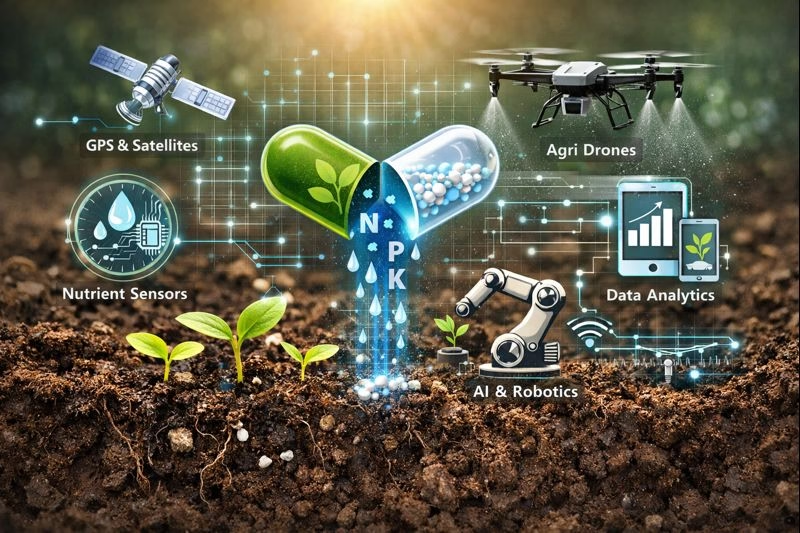
Africa’s high mobile phone penetration is accelerating the scale-up of precision agriculture. Digital platforms now deliver real-time, localized agronomic advice on fertilizer use, weather, pests, and crop management.
Examples across the continent include:
- Zenvus (Nigeria) – soil data collection and crop monitoring
- UjuziKilimo (Kenya) – data-driven farm analytics and advisory
- AgriEdge (Morocco) – satellite, drone, and sensor-based decision support
Decision-support tools such as Nutrient Expert, Rice Advice, and Fertilizer Optimizer provide crop- and site-specific fertilizer recommendations adapted to local conditions.
Economic and environmental benefits
Precision fertilizer use consistently delivers strong economic returns:
- Comparable or higher yields using two to three times less fertilizer
- Fertilizer efficiency gains of approximately 50%
- Lower financial risk for smallholder farmers
Environmental benefits include reduced nutrient runoff, lower greenhouse gas emissions associated with fertilizer use, and improved soil health over time.
Evidence also shows that concentrating fertilizer on smaller, well-managed plots often produces better results than spreading limited inputs across larger areas—an important insight for resource-poor farmers.
Enabling scale through policy and partnerships
Scaling precision fertilizer use requires supportive policies and coordinated action. Precision agriculture aligns closely with the African Union Digital Transformation Strategy (2020–2030) and commitments from the 2024 Africa Fertilizer and Soil Health Summit, which aim to provide location-specific agronomic recommendations to the majority of African smallholders by 2034.
AFIDA emphasizes the need for governments and partners to:
- Maintain affordable fertilizer access through smart subsidies and tax exemptions
- Invest in digital infrastructure and extension systems
- Support research and development of locally adapted precision technologies
- Partner with the private sector to deploy scalable solutions
Conclusion: Efficiency as Africa’s advantage
Africa’s agricultural transformation does not depend only on matching fertilizer use levels in other regions. It also depends on using fertilizer more effectively than anywhere else in the world.
Precision agriculture is already delivering:
- Yield increases of up to 120%
- Fertilizer efficiency gains of around 50%
- Measurable income growth for smallholder farmers
The technologies work. The evidence is clear.
The priority now is scaling proven solutions to reach millions of farmers across the continent.
At AFIDA, we remain committed to engagements that advances policies, partnerships, and industry action that promote smarter fertilizer use, healthier soils, and sustainable agricultural growth in Africa.
References
- iSDAsoil. Digital soil mapping for Africa.
- Onyango, C. M., et al. (2021). Precision agriculture for resource use efficiency in smallholder farming systems in sub-Saharan Africa. Sustainability, 13(3), 1158.
- IFDC. (2022). Micro-dosing for soil health, nutrition, and food systems in Africa.
- CGIAR. (2021). Fertilizer micro-dosing.
- Aune, J. B., Coulibaly, A., & Giller, K. E. (2017). Precision farming for increased land and labour productivity in semi-arid West Africa. Agronomy for Sustainable Development, 37(3), 16.
- Frontiers in Sustainable Food Systems. (2025). Digitalization of precision fertilization in East Africa.
- African Journal of Agricultural Research. (2017). Fertilizer micro-dosing in West African low-input cereal systems.
- African Plant Nutrition Institute (APNI). (2020). Highlights from the West African Forum on Precision Agriculture.
- TAAT Africa. Precision fertilizer micro-dosing for millet and sorghum yield enhancement.
- UN Africa Renewal. (2016). Innovative use of fertilizers revives hope for Africa’s Green Revolution.