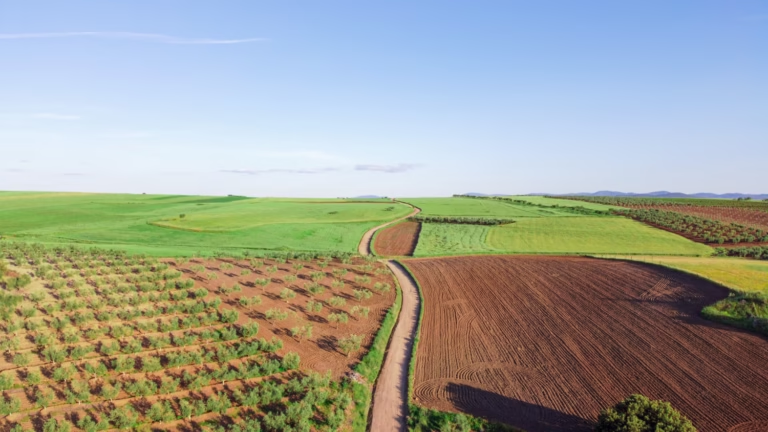

For decades, African agriculture has grappled with a persistent paradox: a continent blessed with 60% of the world’s uncultivated arable land yet struggling with some of the lowest agricultural productivity rates globally. At the heart of this challenge lies soil nutrient depletion and inadequate fertilizer use, a problem that African leaders have sought to address through landmark policy frameworks spanning nearly two decades.
The Abuja Declaration: A Bold 2006 Commitment
When African Union leaders gathered in Abuja, Nigeria, in June 2006, they confronted a stark reality. African farmers were applying an average of just 8 kilograms of fertilizer per hectare, roughly one-tenth of the global average and far below the levels needed for competitive agricultural productivity.
The Abuja Declaration on Fertilizer emerged as a transformative commitment: increase fertilizer use to at least 50 kg/ha by 2015. This wasn’t merely about numbers—it represented a fundamental recognition that Africa’s agricultural transformation required immediate, coordinated action on soil health.
The declaration introduced several groundbreaking mechanisms. The Africa Fertilizer Financing Mechanism (AFFM), managed by the African Development Bank, was established to improve fertilizer availability and finance critical input infrastructure. Countries committed to eliminating taxes and tariffs on fertilizer imports and promoting “smart” subsidies that would reach smallholder farmers more efficiently.
Yet nearly 2 decades later, the results were mixed. While countries like Zambia and Kenya made notable progress, many African nations fell short of the 50 kg/ha target, hampered by high procurement costs, logistical bottlenecks, and inefficient subsidy systems that often benefited larger commercial farmers over smallholders.
Nairobi 2024: A Paradigm Shift Toward Sustainability
Fast forward to May 2024, when African leaders convened in Nairobi for the Africa Fertilizer and Soil Health Summit. The resulting Nairobi Declaration marked not just an update to Abuja’s vision, but a fundamental evolution in thinking about agricultural inputs.
Where Abuja focused primarily on increasing fertilizer consumption, Nairobi introduced a more nuanced, sustainable approach. The new framework sets an ambitious goal: triple domestic production and distribution of both organic and inorganic fertilizers by 2034. But the real innovation lies in its emphasis on targeted, data-driven soil management.
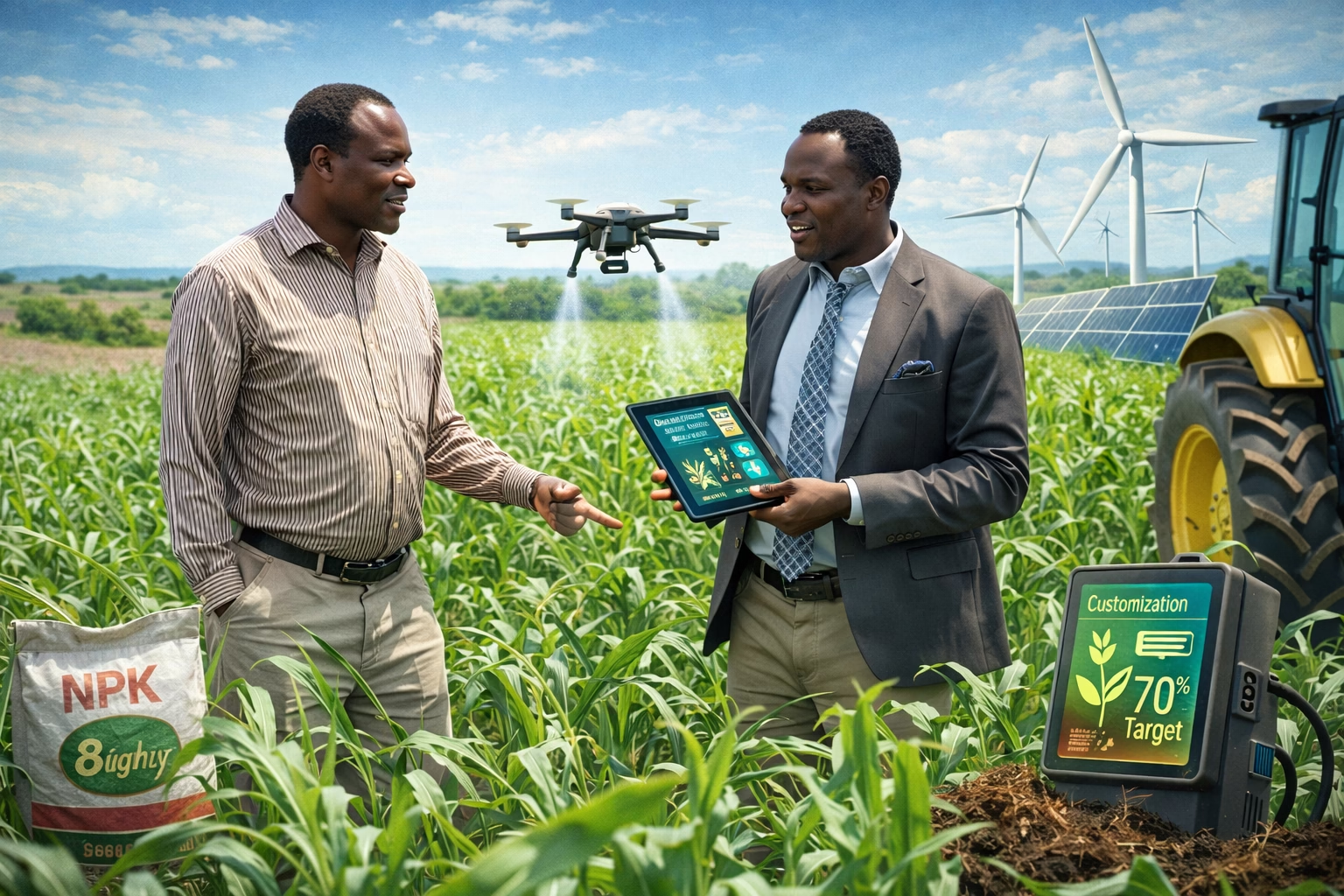
The declaration commits to ensuring that 70% of smallholder farmers have access to location-specific agronomic recommendations by 2034, a recognition that blanket fertilizer application without understanding soil conditions can be wasteful and environmentally damaging. This shift reflects growing awareness that soil health is about more than just adding nutrients; it’s about understanding what each plot of land actually needs.
Smart Subsidies in Action: Country Spotlights
Across the continent, governments are implementing these frameworks with varying degrees of sophistication, collectively spending 20-40% of agricultural budgets on fertilizer subsidies.
Rwanda’s Digital Innovation
Rwanda has emerged as a continental leader with its Smart Nkunganire System (SNS), a digitalized platform that has achieved near-universal coverage among targeted farmers. By using mobile technology and digital vouchers, Rwanda has minimized leakages and ensured subsidies reach intended beneficiaries, a model that other nations are studying closely.
Nigeria’s Scale Challenge
Nigeria’s Presidential Fertilizer Initiative continues to operate at massive scale, facilitating delivery of over 670,000 metric tons of NPK fertilizer. The 2025 federal budget allocates ₦132 billion to agricultural support through the National Agricultural Development Fund, reflecting the government’s continued commitment despite fiscal pressures.
Benin’s Targeted Approach
For the 2024/2025 season, Benin is injecting over $39 million to subsidize fertilizers for specific crops, corn and cotton, selling NPK at 17,000 CFA francs compared to market prices of 24,000 CFA francs. This crop-specific targeting represents an attempt to maximize impact while controlling costs.
The Road Ahead: Challenges and Opportunities
As African nations work toward the Nairobi Declaration’s 2034 targets, several critical challenges remain. Import dependence continues to expose farmers to global price volatility, a lesson reinforced by the fertilizer price spikes following the Russia-Ukraine war in 2022. According to the Food and Agriculture Organization, global fertilizer prices surged by over 30% in 2022, devastating subsidy budgets across Africa.
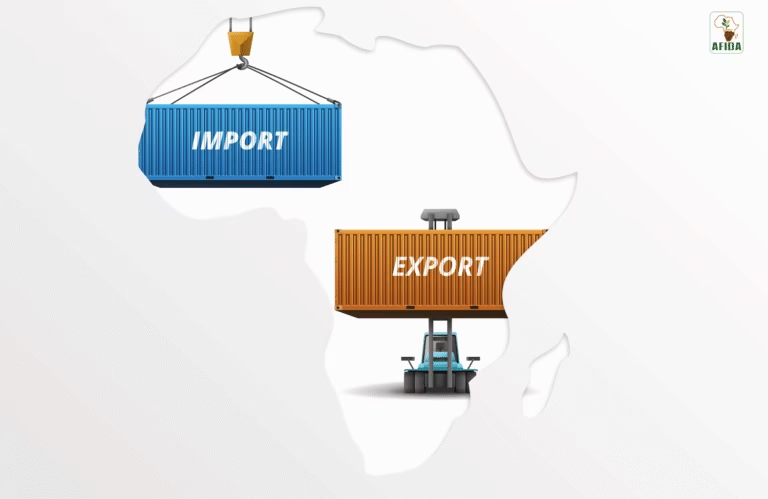
Domestic fertilizer production in Africa is often misunderstood. While the continent is a major producer of fertilizer raw materials and finished products, particularly in North Africa, it exports a large share of this output, leaving many Sub-Saharan countries dependent on imports for 80–90% of their fertilizer needs. The Nairobi Declaration’s call to expand regional manufacturing by 2034 aims to reduce this vulnerability by strengthening processing capacity, energy access, and intra-African supply chains so production better aligns with local consumption.
The shift toward soil-health-focused, precision agriculture also demands investments in agricultural extension services, soil testing laboratories, and digital infrastructure—areas where many African countries currently fall short. Yet this is also where the greatest opportunities lie.
Emerging technologies—from satellite imagery for soil analysis to AI-powered recommendation systems—could leapfrog traditional extension models. Public-private partnerships, emphasized in the Nairobi Declaration, could bring private sector innovation and efficiency to last-mile delivery challenges that have long plagued government programs.
Conclusion: A Decade of Transformation Ahead
The journey from Abuja 2006 to Nairobi 2024 reflects a maturing understanding of what African agricultural transformation truly requires. It’s not just about applying more fertilizer; it’s about applying the right fertilizer, in the right place, at the right time, in ways that build long-term soil health rather than merely extracting short-term yields.
As African nations work toward the 2034 targets, success will require sustained political commitment, smarter subsidy design, increased domestic production, and leveraging technology to deliver personalized agronomic advice to millions of smallholder farmers. The framework is in place; the next decade will determine whether Africa can finally unlock its agricultural potential and turn the promise of these declarations into food security reality for its rapidly growing population. The stakes couldn’t be higher with Africa’s population projected to reach 2.5 billion by 2050, according to United Nations estimates. Agricultural transformation isn’t just an economic priority; it’s an existential imperative.