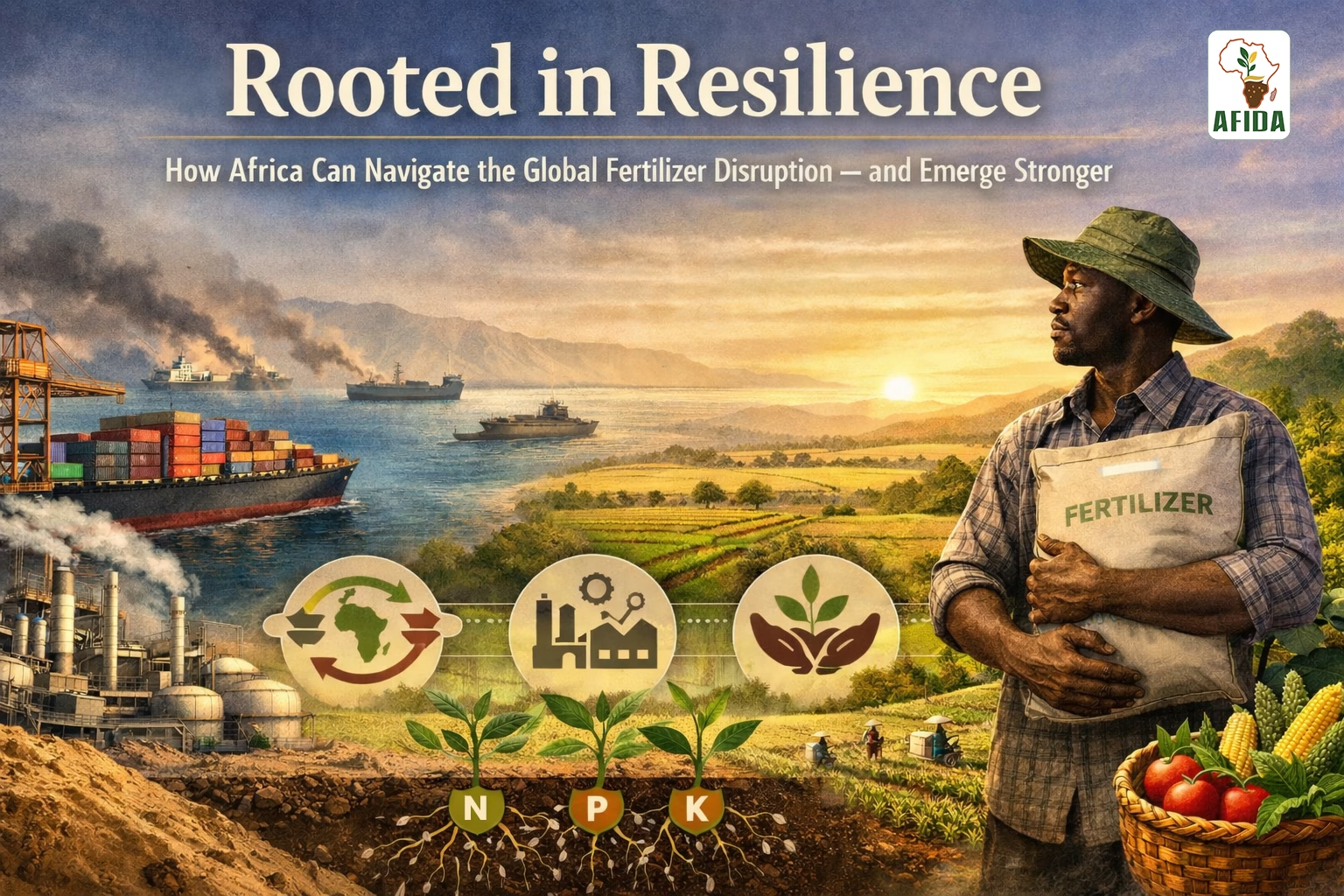

An informational article on global supply shifts, Africa’s enduring agricultural strength, and the paths forward for farmers and policymakers
| Editorial Note: This article is presented in a neutral, informational tone. It does not advocate for any political position or seek to cause alarm. The aim is to equip readers with a clear understanding of current supply dynamics — and the genuine opportunities for constructive response. |
Understanding the Moment — and Africa’s Place in It
Events unfolding in the Persian Gulf region have drawn the attention of governments and markets worldwide. Military hostilities between the United States/Israel, and Iran have disrupted key shipping corridors and placed pressure on global energy and commodity supply chains. These are serious developments, and it is right that they be taken seriously.
At the same time, it is worth remembering that disruption and challenge, while uncomfortable, have historically served as the conditions under which meaningful transformation takes place. Africa’s agricultural sector, often underestimated, frequently overlooked in global conversations, carries within it a depth of adaptive capacity and untapped potential that gives genuine cause for measured optimism, even in a difficult moment.
This article examines what is happening in global fertilizer markets, what it means for African farming communities, and importantly, the very real opportunities that this moment may create for a more self-reliant, diversified, and resilient African agricultural future.
| Disruption, when met with clarity and purpose, has a way of accelerating change that was needed long before the disruption arrived. |
The Waterway That Feeds the World’s Farms
Between the southern coast of Iran and the northern tip of the Omani peninsula lies one of the most consequential stretches of sea in the modern world. The Strait of Hormuz, at its narrowest, is a passage of only a few kilometers, 33KM, yet through it flows a vast share of the world’s energy exports, and with them, a significant portion of the raw materials from which the world’s fertilizers are made.
The Persian Gulf states — Qatar, Saudi Arabia, the United Arab Emirates, and others — have over decades built some of the largest fertilizer production complexes on earth. The reason for this concentration is straightforward: the region sits atop enormous reserves of natural gas, and natural gas is the primary feedstock for ammonia, which is in turn the foundation of nitrogen-based fertilizers. What was once an energy windfall became, in time, an agricultural industrial base serving farmers on nearly every continent.
| The Persian Gulf did not merely become a supplier of energy to the world. It became, quietly and structurally, one of the most important suppliers of the inputs that allow the world to grow its food. |
Africa has been among the most consistent recipients of this supply. Fertilizer produced in Gulf facilities have for years made their way to ports along the West African coast, across the Indian Ocean to East African nations, and southward to the commercial farming regions of southern Africa. The relationship has become deeply embedded in the continent’s agricultural supply chains.
The current conflict has placed this entire system under considerable strain. Commercial shipping through the Strait has been disrupted. Major international carriers have suspended or fundamentally altered their Gulf routes. Production at key facilities has been affected as energy infrastructure within the region has come under pressure. The fertilizer that was being produced, loaded, and shipped toward African ports has, in many cases, stopped moving.
This is a real and meaningful disruption. It deserves honest acknowledgement. But it is also a disruption that is manageable — and one that, with the right responses, may ultimately redirect long-overdue investment and attention toward Africa’s own agricultural foundations.
| The world’s fertilizer system is not broken, it is being redirected. And in that redirection lies a genuine opportunity for African agriculture to claim a more central role in feeding itself. |
What Disruption Means for African Agriculture
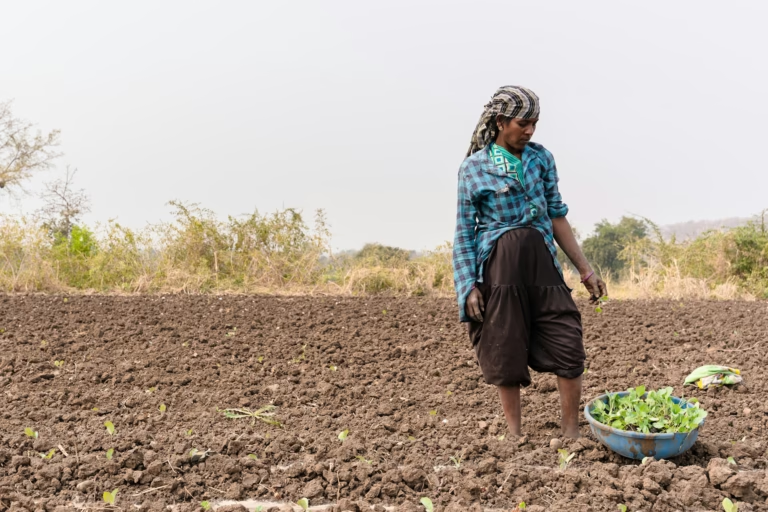
To understand the weight of this disruption, it is necessary first to understand the position African agriculture occupies in relation to its inputs. Across much of the continent, the use of synthetic fertilizer has historically been well below what agronomists recommend for productive and sustainable farming. Soils in large parts of sub-Saharan Africa are nutrient-depleted from decades of cultivation without adequate replenishment. Farmers have often been constrained not only by knowledge of what their soils require, but by the cost and availability of what is needed to address those requirements.
This is the landscape into which the current supply shock is arriving. It is not arriving into a system with surplus capacity or comfortable buffers. It is arriving into a system that had enough but always exported out.
The Cost Dimension
When supply contracts and demand remain constant, prices rise. This is the first and most visible effect that African farmers and agricultural businesses are beginning to experience. Fertilizer that was already a significant line item in a farmer’s seasonal budget has become more expensive. For smallholder farmers operating on thin margins, this does not represent an inconvenience. It represents a decision about whether to plant, how much to plant, and whether the expected harvest can justify the upfront cost.
The situation is made more complex by freight cost increases. Shipping lines that have rerouted their vessels away from the Gulf are absorbing additional costs; longer voyages, higher insurance premiums, increased fuel consumption, and those costs are not absorbed quietly. They are passed on through the supply chain. By the time fertilizer reaches a West African port or an East African distributor, it carries with it the accumulated burden of a trading system that has been forced to work much harder than it was designed to.
The Availability Dimension
Beyond price, there is the more fundamental question of physical availability. A farmer who can afford fertilizer but cannot obtain it is in no better position than one who cannot afford it. In several parts of Africa, the pipelines that normally deliver inputs ahead of planting season have been disrupted. Importers who typically work months in advance are finding that their established suppliers are operating under reduced capacity or have redirected available supply toward other markets. Alternative sourcing is possible, but it is neither immediate nor straightforward.
There is also a timing dimension that is rarely discussed but is critical to understand. Agricultural systems are not fluid. They move according to seasons, and seasons do not pause for supply chain disruptions. A fertilizer shipment that arrives after planting has occurred is, for that season, no fertilizer at all. The window in which inputs must be secured and applied is narrow, and the current disruption is affecting precisely that window for many regions across the continent. To put things into perspective, here are the key regional differences:
- Coastal West Africa (Cocoa): The mid-crop season is driven by rain from March to August
- Southern Africa: The main summer cropping season runs from October to March/April.
- Western Africa: Planting typically starts in March-April for coastal areas, with the season for the Sahel zone running from June-July to October-November.
- Nigeria: Southern areas see planting from March, while the North starts in May or June, following the rainy season.
What This Means for African Farmers — Honestly and Hopefully
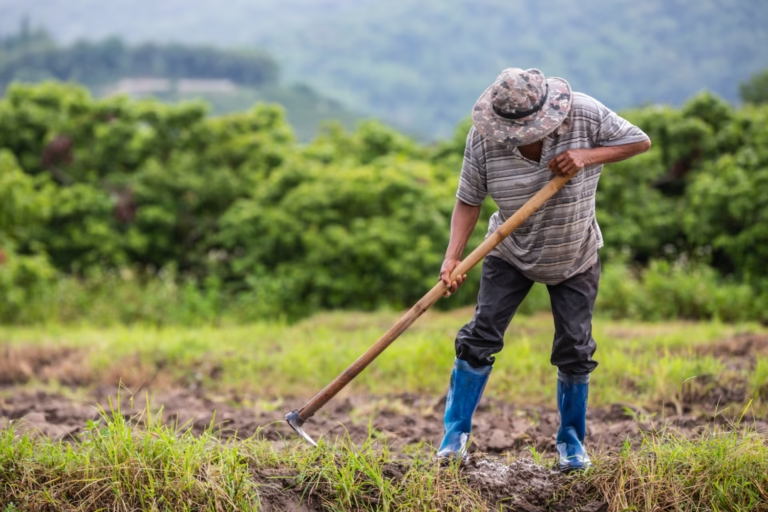
It would not serve the farming communities of this continent to pretend that the current disruption carries no consequences. In many parts of Africa, fertilizer costs already represent a significant share of what it takes to bring a crop to harvest. A tightening of supply and an increase in prices is felt not as an abstraction but as a lived reality, in decisions about how much to plant, how much to apply, and whether a season will deliver what a family is counting on.
These challenges are real. They deserve serious policy attention and practical support. And yet alongside the honest account of difficulty, it is equally important to recognize what African farming communities have always brought to adversity: creativity, community, and an enduring commitment to making things work.
West Africa: Pivoting with Purpose
Across West Africa, agricultural importers and trade bodies have already begun identifying and engaging alternative fertilizer suppliers. The conversations now happening with North African producers, Eastern European suppliers, and regional blending facilities are not merely emergency responses. They are the early stages of a more diversified, more resilient supply landscape, one that was arguably overdue. The present difficulty may well prove to be the catalyst that builds something more durable than what existed before.
East Africa: A Spur to Regional Self-Sufficiency
East Africa’s exposure to dual disruptions, in both the Persian Gulf and the Red Sea corridor, is real, but it is also shining a spotlight on the region’s own considerable potential. East Africa sits atop significant phosphate and potash deposits. It has agroecological conditions that support the production of organic soil amendments at scale. And it has a growing network of agricultural research institutions and extension services that are already working to reduce dependence on imported inputs. The current moment may well accelerate that work in ways that serve the region for decades to come.
Southern Africa: Strength in the Foundation
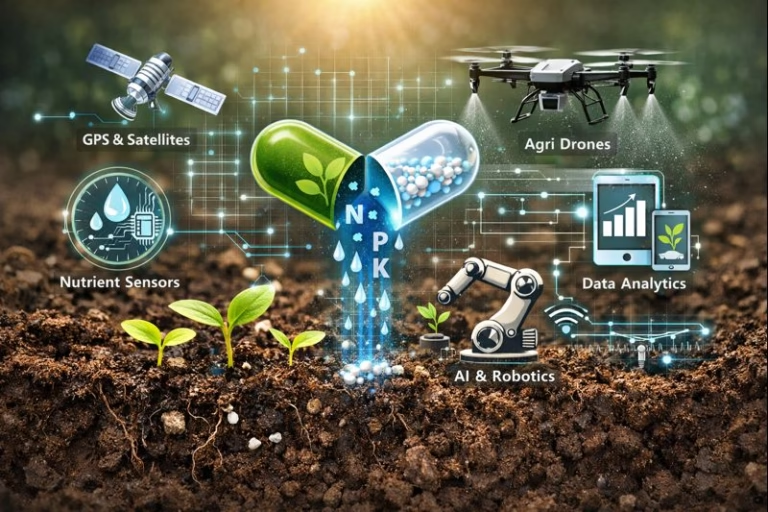
Southern Africa’s commercial farming sector is among the most technically sophisticated on the continent. It has navigated input shocks, currency volatility, and climate stress before, and it has done so by drawing on knowledge, community, and adaptive management. The current disruption adds pressure to an already challenging environment, but it also presents an opportunity to deepen the region’s engagement with soil health practices, precision input application, and the development of local input supply chains that reduce vulnerability to future external shocks.
The Deeper Opportunity: Africa’s Agricultural Future
There is a broader conversation that the current moment invites: one about the structural place of African agriculture in the global food system and what a more resilient African food future could look like.
Africa holds a remarkable share of the world’s uncultivated arable land, significant mineral resources relevant to fertilizer production, and a young, growing population with both the need and the capacity to develop a thriving agricultural economy. The continent is not a passive recipient of global supply chains. It is a potential engine of global food production, one whose full potential has, for a variety of historical and structural reasons, not yet been realized.
The current disruption raises an important question in a new and urgent way: what would it take for African countries to produce more of their own agricultural inputs, build more of their own processing capacity, and trade more of their food within and between African markets? These are not new questions. But they may find new political will and new investment attention in the wake of a disruption that has made the vulnerabilities of import dependence visible in ways they were not before.
| Africa’s agricultural future does not have to be written around the disruptions of others. It can be written around the strengths it already possesses — and the investments it is now motivated to make. |
Paths Forward: Actions That Can Make a Difference
Across the range of possible responses to the current situation, a number of avenues appear promising. They are offered here not as prescriptions but as directions that thoughtful actors, in government, in the private sector, and in farming communities, are already beginning to explore.
Strengthening Regional Agricultural Trade
The African Continental Free Trade Area (AfCFTA) has created a framework for exactly the kind of regional agricultural integration that reduces vulnerability to external supply shocks. Accelerating the implementation of agricultural trade provisions under this framework — making it easier for fertilizer produced in one African country to reach farmers in another, and for food surpluses in one region to address deficits in another — is both timely and achievable.
Diversifying Supply Sources
Governments and agricultural agencies that move proactively to establish supply relationships with alternative fertilizer producers are likely to find themselves better protected not only in this moment but in future ones. Morocco’s, Nigeria’s, Egypt’s fertilizer industry, and producers in Eastern Europe all represent sources that are accessible and, in many cases, willing to engage. The groundwork being laid now is an investment in supply chain resilience that will pay dividends beyond the current disruption.
Investing in Domestic Input Production
Several African nations have the raw materials and the industrial capacity to develop domestic fertilizer production at meaningful scale. This is not a short-term fix, but it is one of the most valuable long-term responses to the current situation. Governments, development finance institutions, and the private sector all have a role to play in accelerating these investments and the current moment may provide exactly the political and economic motivation needed to move from intention to action.
Supporting Farmers Through the Transition
The farmers most exposed to the current disruption are, in many cases, those with the fewest resources to absorb it. Targeted input support, flexible credit facilities, and strengthened agricultural extension services can help ensure that smallholder farmers are not left to navigate this moment alone. Investing in the resilience of the smallholder sector is not simply a social good; it is the foundation of national food security and long-term agricultural productivity.
Embracing Soil Health as a Strategic Asset
Africa’s soils, in many areas underserved for decades, have more to offer than their current yields suggest. Investment in soil testing, composting programmes, biological and mineral input options, and training in integrated soil fertility management can meaningfully improve yields. Framing this not as a crisis response but as a strategic upgrade of Africa’s agricultural infrastructure reflects the genuine opportunity it represents. In fact, Integrated Soil Fertility Management (ISFM) in Africa is actively implemented by organizations like the International Institute of Tropical Agriculture (IITA), Forum for Agricultural Research in Africa (FARA), Alliance for a Green Revolution in Africa (AGRA), Soil Values, One Acre Fund, and many more across the research institutes, private sector, and development space, are focusing on combining organic fertilizers, mineral fertilizers, and improved germplasm.
A Moment of Honest Optimism
African agriculture has always been asked to do more with less, and it has, generation after generation, found ways to do exactly that. The current disruption is a genuine test of supply chains, of policy capacity, and of the resourcefulness that African farming communities have consistently demonstrated.
But it is also a moment of genuine opportunity. Supply shocks, when they arrive, tend to accelerate structural changes that were already needed. The overdependence on a narrow set of foreign input suppliers was always a vulnerability. The underinvestment in domestic production capacity and trade facilitation across the continent was always a gap. The unavailability of surplus supply and buffer stocks doesn’t leave room for mitigating shocks for rainy days. The potential of African soil health and regional food trade was always underutilized. The present moment is not the cause of these realities. It is simply making them visible, and in doing so, making the case for addressing them more urgent and more compelling than it has ever been.
The path forward requires clear thinking, coordinated action, and a willingness to invest in solutions that will outlast the current disruption. There is every reason to believe that African governments, institutions, and farming communities are capable of exactly that.
| The challenge in front of African agriculture is real. So is the potential. And the history of this continent’s farmers is, above all else, a history of turning difficult moments into durable strength. |