
The Hidden Crisis Beneath Our Feet
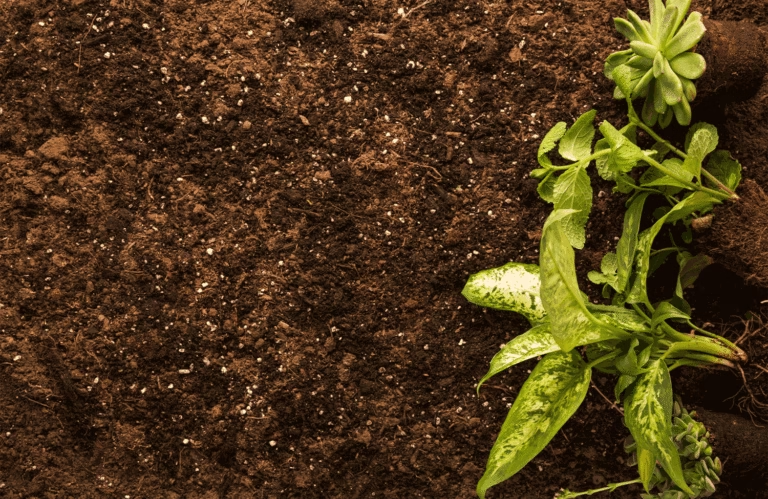
Africa faces a silent emergency that threatens food security for millions: soil degradation. Approximately 75-80% of Africa’s cultivated area is degraded, losing 30-60 kg of nutrients per hectare annually and affecting more than 485 million people. This crisis costs the continent an estimated $4 billion in lost soil nutrients each year.
Yet there’s hope. The 2024 Africa Fertilizer and Soil Health Summit in Nairobi showed that African leaders are taking action, with commitments to reverse land degradation on 30% of degraded soils by 2034 through integrated soil and water management practices.
Understanding the Problem: Nutrient Mining
For decades, African soils have been “mined”—nutrients are extracted through harvests but never replaced. The numbers tell the story: while global fertilizer use averages 135 kg per hectare, Africa uses only 21.6 kg per hectare, with some countries applying as little as 0.2 kg/ha.
This creates a vicious cycle: poor soils produce low yields, leaving farmers with little income to invest in inputs, which further depletes the soil. In sub-Saharan Africa, 65% of arable land is degraded, with consequences including declining yields, forest clearing for new farmland, climate vulnerability, and persistent poverty.
Why Fertilizers Matter (When Used Right)
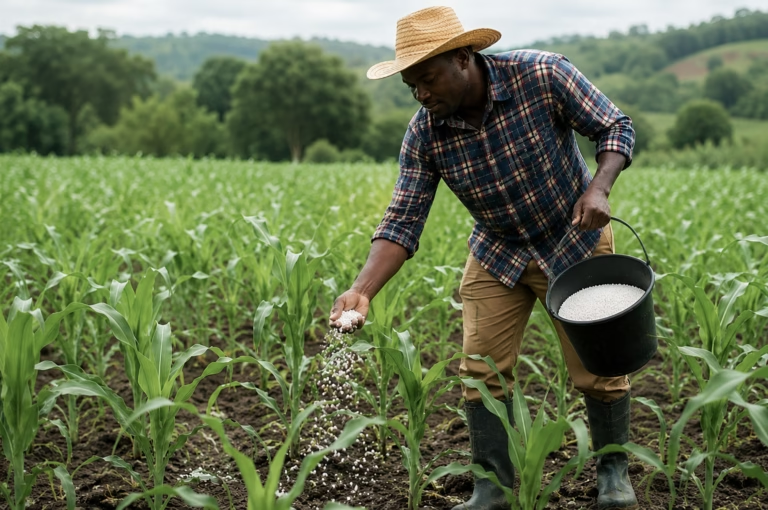
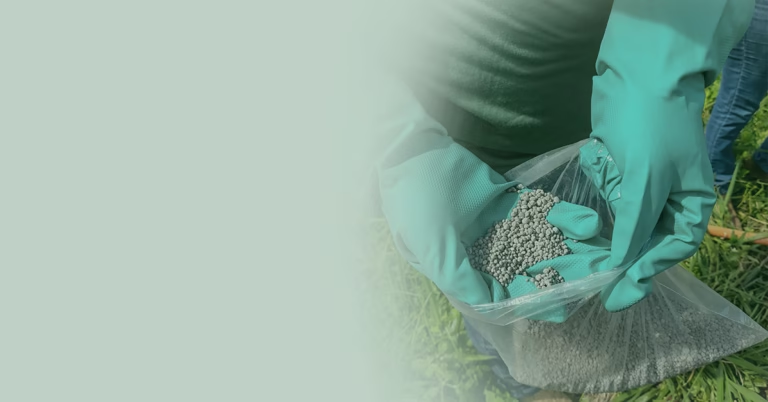
Fertilizers in organic or mineral forms aren’t harmful chemicals—when used properly as part of integrated soil management, they’re essential tools for restoring soil health.
The 2006 Abuja Declaration set a target to increase fertilizer use from 8 kg/ha to at least 50 kg/ha—the minimum threshold for sustainable agricultural growth. Countries that made progress saw real benefits. Between 2005 and 2015, Ethiopia’s fertilizer use increased from 11 kg to 24 kg per hectare, Ghana’s from 20 kg to 35 kg per hectare, and Kenya’s from 33 kg to 44 kg per hectare, resulting in increases in farm yields.
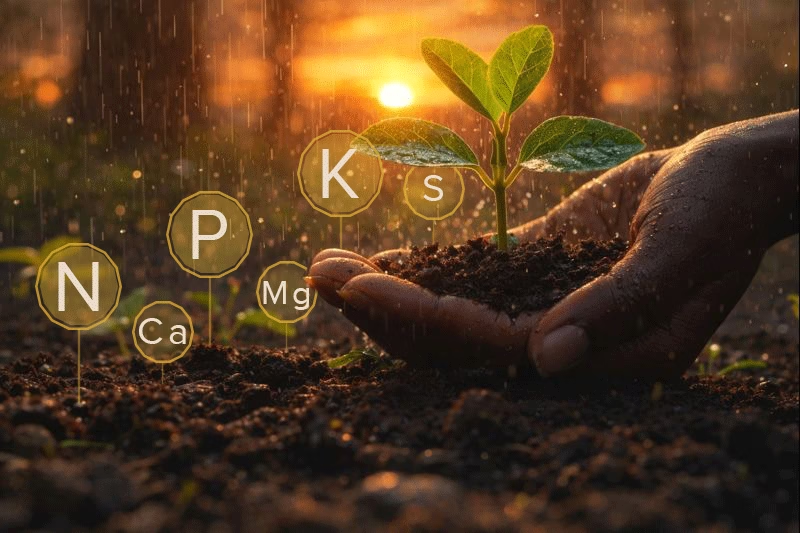
However, African soils face deficiencies in multiple nutrients beyond macro-nutrients (nitrogen, phosphorus, and potassium), including sulfur, zinc, and boron. Addressing only one deficiency yields limited results—all must be corrected for optimal productivity.
A Solution: Integrated Soil Fertility Management (ISFM)
The future isn’t choosing between fertilizer use and conservation agriculture, or between organic and inorganic fertilizers—it’s integrating all. ISFM combines mineral fertilizers, organic inputs, improved seeds, and conservation based on knowledge of local conditions to maximize nutrient efficiency and crop productivity.
What ISFM Includes:
- Improved crop varieties that use nutrients efficiently
- Mineral fertilizers to address nutrient deficiencies quickly
- Organic resources like compost and manure to build soil structure
- Conservation practices tailored to local conditions—crop rotation, agroforestry, and water management
The Results Speak for Themselves
ISFM has increased maize yields by 15-145% in semi-arid areas, with yields ranging from 4,200 to 5,500 kg per hectare. These aren’t marginal improvements—they’re transformational.
Research from Tanzania shows that as farmers adopt more ISFM components, yields increase progressively. Farmers using all components achieved the highest yields, proving that integrated approaches deliver superior results.
Economically, ISFM can double productivity and increase farm-level incomes by 20 to 50 percent when implemented correctly.
Real Stories of Transformation
Loti Philemon Malekela in Dodoma, Tanzania, watched soil erosion undermine his farming efforts for years. After adopting soil and water conservation practices, his maize yield jumped from 3 bags per acre to 18 bags within five years. Today, he trains hundreds of other farmers in these techniques.
Yacouba Sawadogo in Burkina Faso earned international recognition as “the man who stopped the desert” by restoring 62 acres of degraded land through traditional techniques like zai pits combined with agroforestry.
These stories prove that sustainable soil management isn’t theoretical—it’s practical, achievable, and transformative.
The Climate Connection
Soil health and climate change are interconnected. Healthy soils store carbon and build resilience against droughts and floods. Degraded soils release carbon while becoming more vulnerable to climate shocks.
Current soil degradation rates are up to 100 times higher than natural regeneration rates, costing Africa an estimated $68 billion annually in lost crop yields. Climate change makes this worse through increasing droughts and floods.
ISFM offers climate benefits by improving soil carbon levels, enhancing water retention, and reducing excessive fertilizer use through better efficiency.
The Nairobi Declaration: A New Vision
The 2024 summit marked a shift from just focusing on fertilizer access to comprehensive soil health. The Nairobi Declaration endorses a 10-year action plan to rebuild soil fertility and increase the profitability of fertilizer use.
Key 2034 Targets:
- Triple fertilizer production locally to reduce import dependence
- 70% of smallholder farmers receive targeted agronomic recommendations
- Reverse degradation on 30% of degraded soils through integrated management
- 70% access to quality extension services on fertilizer and soil health
- $15 billion in private sector investment for local fertilizer manufacturing
What Needs to Happen Now
1. Smart Policies
Governments must keep fertilizers accessible and affordable. This means maintaining tax exemptions on agricultural inputs, harmonizing regional trade, and investing in extension services. Policies that increase fertilizer costs—like removing VAT exemptions—risk reversing decades of progress.
2. Private Investment
A significant $15 billion of private sector investment is needed to triple local production of organic and inorganic fertilizers by 2033. This requires stable policies and profitable market opportunities.
3. Knowledge Transfer
Technology exists to address Africa’s soil health challenges, but many farmers lack access to information. Digital soil mapping, precision agriculture tools, and mobile advisory services offer promising solutions. The iSDAsoil initiative’s continental digital soil map at 30-meter resolution shows how technology can democratize soil information access.
4. Regional Cooperation
Soil health crosses borders. Regional frameworks like the Economic Community of West African States (ECOWAS) and Union Économique et Monétaire Ouest-Africaine (UEMOA) have harmonized fertilizer regulations and promoted free input movement. Likewise, the African Continental Free Trade Area (AfCFTA) strengthens these regional efforts by reducing intra-African tariffs on fertilizers, promoting harmonized sanitary/phytosanitary standards, and facilitating seamless, tax-free cross-border movement. This enables larger-scale, affordable distribution of locally produced nutrients. All, supporting the 2023 Lomé Declaration’s goal of boosting soil health across the continent, where fertilizer’s status as a strategic product was confirmed, thereby guaranteeing free movement and tax-free status within member states.
Countries that deviate from this regional consensus risk isolating themselves and disadvantaging their farmers.
Addressing Common Questions
“Aren’t fertilizers bad for the environment?”
When used appropriately, fertilizers enhance soil health. The key is balanced application—right product, right rate, right time, right place. Combined with organic matter, they improve efficiency while minimizing environmental losses.
“Can’t we just use organic methods alone?”
Past efforts focusing on inorganic fertilizer alone had limited success where soils are already degraded. The solution isn’t either/or—it’s both. Organic materials build soil structure while mineral fertilizers address acute deficiencies.
“Is this affordable for smallholder farmers?”
While ISFM requires upfront investment, the returns justify the costs. Yield increases of 15-300% far exceed input costs. Policies maintaining affordable access through tax exemptions or financing mechanisms enable broader adoption.
The Bottom Line
Africa’s agricultural transformation depends on healthy soils. Without addressing soil degradation, investments in improved seeds, irrigation, and markets won’t reach their potential. Limited by soil degradation, yield increases from improved varieties are only 28% in Africa compared to 88% in Asia.
The good news? We know what works. ISFM practices, supported by smart policies, farmer training, and functioning input markets, can reverse decades of degradation.
What’s needed is commitment: from governments to maintain supportive policies, from the private sector to invest in production, from development partners to provide support, and from farmers to adopt integrated practices.
The Nairobi Declaration charts the path forward. Success depends on translating commitments into action—ensuring fertilizers remain accessible, farmers receive training, soil health becomes central to planning, and necessary investments materialize.
Soil health isn’t just agricultural—it’s the foundation for food security, climate resilience, rural prosperity, and national development. As African leaders declared in Nairobi, the time to “listen to the land” is now.
The question isn’t whether Africa can afford to invest in soil health, but whether it can afford not to.
Key References
- Approaches to improve soil fertility in sub-Saharan Africa. (2019). PMC6946000. https://pmc.ncbi.nlm.nih.gov/articles/PMC6946000/
- African Union Development Agency (AUDA-NEPAD). (2024). Briefing Note: Addressing Africa’s soil health challenges through the ten-year African Fertilizer and Soil Health Action Plan (2024-2034). https://www.nepad.org/publication/briefing-note-addressing-africas-soil-health-challenges
- Kihara, J., et al. (2024). Soil Health Challenges in Sub-Saharan Africa: Status and Solutions. Growing Africa. https://growingafrica.pub/soil-health-challenges-in-sub-saharan-africa-status-and-solutions/
- Mesele, T. (2025). Current Problems Leading to Soil Degradation in Africa: Raising Awareness and Finding Potential Solutions. European Journal of Soil Science. doi: 10.1111/ejss.70069
- UN Africa Renewal. (2016). Innovative use of fertilizers revives hope for Africa’s Green Revolution. https://www.un.org/africarenewal/magazine/august-2016/innovative-use-fertilizers-revives-hope-africa’s-green-revolution
- International Fertilizer Development Center (IFDC). Integrated Soil Fertility Management (ISFM). https://ifdc.org/integrated-soil-fertility-management-isfm/
- Vanlauwe, B., et al. (2015). Integrated soil fertility management in sub-Saharan Africa. SOIL, 1, 491-508.
- Kihara, J., et al. (2022). Contributions of integrated soil fertility management (ISFM) to various sustainable intensification impact domains in Tanzania. Agricultural Systems, 201, 103458.
- African Union. (2024). Nairobi Declaration – 2024 Africa Fertilizer and Soil Health Summit. https://au.int/en/documents/20240509/nairobi-declaration-2024-africa-fertilizer-and-soil-health-summit
- FAO. (2022). World fertilizer trends and outlook to 2024. Rome. FAOSTAT Analytical Brief 47.