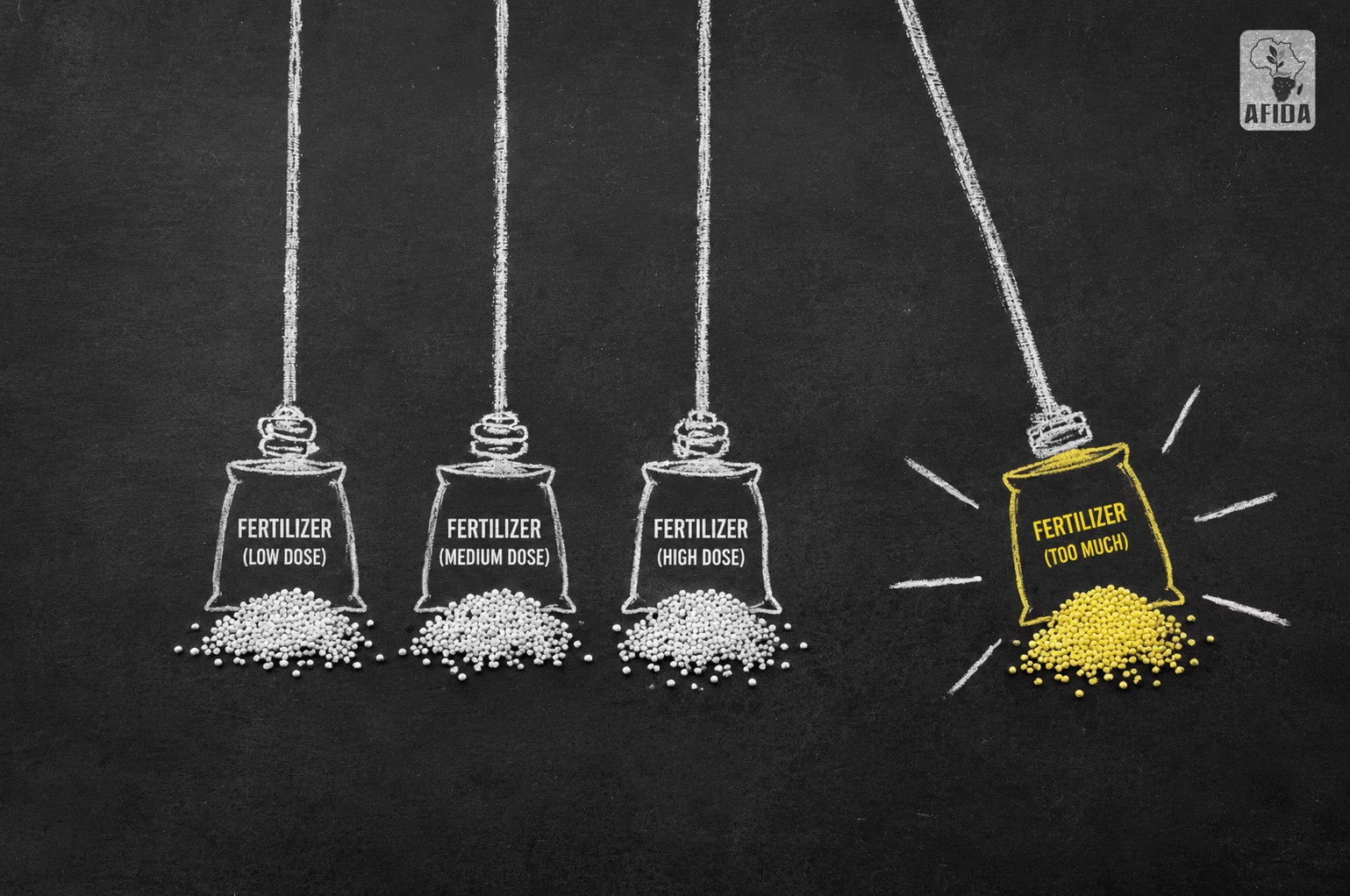

In its agricultural form, the paradox was sharpened by researchers like Esther Duflo and Michael Kremer, who studied Kenyan maize farmers in the early 2000s. Their findings were startling: fertilizer use was economically rational, returns were often 50 to 100 percent above cost, and yet farmers who knew this still didn’t buy it. Or they bought it at harvest time, when cash was available, only to forget to apply it when planting season came months later. Or they applied it and lost the crop to drought before it could pay off, both latter conditions owing to the farmers’ knowledge gap.
The paradox, then, is not also of ignorance. It is also of structure. The barriers are not only in farmers’ minds. They are in markets, in weather, in credit systems, in the peculiar physics of African soil chemistry, and in the compounding uncertainty that governs life at the bottom of the economic ladder.
Why African Soils Are Different
To understand the paradox in Africa specifically, you have to understand what African soils are and what they are not.
Much of sub-Saharan Africa’s farmland sits on ancient geological formations, the remnants of the Gondwana supercontinent. These soils are highly weathered, meaning millennia of tropical rain have leached away the nutrients that make temperate soils productive. They are often acidic. They are frequently deficient not just in nitrogen, phosphorus, and potassium, but in micronutrients like zinc, boron, and sulfur that are rarely addressed by standard fertilizer blends.
Here lies the first layer of the paradox: the fertilizer available to most African farmers is not designed for African soil. The global fertilizer industry, dominated by production in Russia, China, and the Middle East, produces products calibrated to different soil profiles. A bag of urea or DAP (diammonium phosphate) applied to an acidic, zinc-depleted smallholder plot in Malawi may produce a fraction of the yield it would produce in Iowa. The farmer sees a weak return. He concludes fertilizer doesn’t work. He is not wrong about what he observed.
The Economics of Risk and Poverty
The second layer of the paradox is about what economists call risk aversion under poverty, a dynamic that is rational in ways that outsiders frequently misunderstand.
For a farmer in the United States, applying fertilizer and losing the crop to drought is painful but survivable. Insurance, credit, savings, off-farm income, any of these can cushion the blow. For a smallholder farmer in northern Nigeria or southern Zambia, losing a crop is an existential event. It can mean pulling children from school, selling livestock, going into debt to a local moneylender at punishing rates.
In this context, the decision not to buy fertilizer on credit, even when the expected return is positive, is not irrational. It is a survival calculation. The downside of being wrong is catastrophic in a way that no expected-value calculation fully captures. This is the poverty trap made concrete: the very conditions that make investment most necessary are the same conditions that make investment most dangerous.
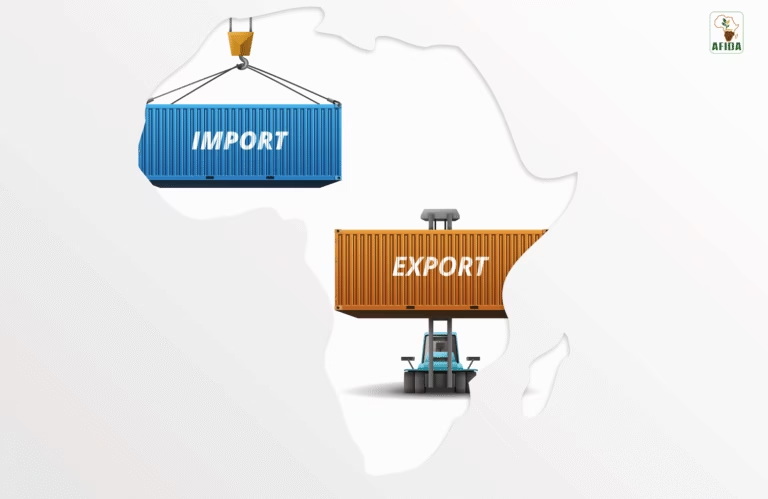
Access compounds this. Fertilizer in much of rural Africa is expensive, not just in absolute terms, but relative to crop prices. Poor road infrastructure, fragmented markets, and thin supply chains mean that a farmer in rural Mozambique may pay twice the world price for a bag of fertilizer, while receiving half the world price for the grain she sells. The scissors of this price ratio cut out any margin for investment.
The Subsidy Trap
Governments and donors, recognizing these barriers, have repeatedly turned to subsidies. Nigeria, Zambia, Ghana, Ethiopia, Malawi. The history of African agricultural policy is littered with fertilizer subsidy programs. And yet the results have been consistently mixed, for reasons that form another layer of the paradox.
Subsidies, in theory, lower the cost barrier and stimulate adoption. In practice, they have often been captured by wealthier, better-connected farmers, the ones who didn’t need them most. They have distorted local markets, undercutting private dealers who then exit the market, leaving infrastructure gaps that outlast the subsidy itself. They have been delivered late, when planting windows have already closed. And they have often subsidized the wrong products, generic fertilizers that don’t address the specific deficiencies of local soils.
Malawi’s famous fertilizer subsidy program, termed Agricultural Input Subsidy Program (AISP), and later termed Farm Input Subsidy Program (FISP) often cited as a success in the mid-2000s, achieved genuine yield improvements, but at fiscal costs that proved unsustainable, and with concerns about crowding out private market development that have not fully resolved.
The paradox of the subsidy is that the cure can, if badly administered, worsen the underlying disease.
Green Shoots: What Is Working
The picture is not uniformly bleak. Across Africa, researchers, entrepreneurs, and farmers themselves are working around the edges of the paradox in ways that suggest a path forward.
Micro-dosing, applying very small, precisely timed quantities of fertilizer near the seed rather than broadcast across a field, has been shown to dramatically improve returns on investment for resource-limited farmers in the Sahel. It reduces cost, reduces risk of loss, and is compatible with the realities of a farmer who may only have 5,000 naira to invest at planting time.
Blended and soil-specific fertilizers are gaining ground. Many blending companies are constantly working to develop fertilizer blends calibrated to specific African soil types, addressing zinc deficiencies in eastern Africa, sulfur gaps in western Africa, and the chronic acidity of the Congo Basin. Fertilizer blending companies in Africa are experiencing rapid growth and a strategic shift from transforming finished products to local formulation, driven by the need for crop-specific, soil-tailored nutrients.
Digital advisory services, delivered via basic mobile phones, are reducing the information asymmetry that leaves many farmers applying fertilizer at the wrong time or in the wrong combination. Services in Kenya, Tanzania, and Nigeria now provide localized, crop-specific guidance based on soil data and weather forecasting.
Input credit linked to output markets, sometimes called “nucleus farmer” or “contract farming” models, allows smallholders to receive fertilizer on credit, with repayment automatically deducted when they sell their harvest to an aggregator. This removes the timing problem and the cash constraint simultaneously, without requiring a formal banking relationship.
The Deeper Lesson
The fertilizer paradox is, in the end, a lesson in systems thinking. No single intervention, not subsidies, not education, not better seeds, not mobile apps, resolves it on its own, because the problem is not a single failure. It is a web of interacting constraints: soil chemistry, market access, weather risk, credit availability, policy design, and the fundamental insecurity of a life lived without a safety net.
Africa is not poor in agricultural potential. Its soils, though depleted, are recoverable. Its farmers, though resource-constrained, are sophisticated managers of complex risk environments. Its land area, much of it still uncultivated, dwarfs that of any other continent.
What the fertilizer paradox ultimately reveals is that closing Africa’s agricultural productivity gap requires not just agronomic solutions alone, but institutional ones. Markets that work for smallholders. Insurance products that make risk bearable. Infrastructure that brings input costs down and output prices up. And a policy that is humble enough to learn from the farmer, rather than lecture him.
Sources draw on research by Duflo, Kremer & Robinson (2008, 2011); IFDC Africa Fertilizer Reports; AGRA State of Smallholder Agriculture in Africa; and the African Development Bank’s agricultural development assessments.