
Understanding the 2024 Africa Fertilizer and Soil Health Summit’s Bold Vision
In May 2024, African leaders gathered in Nairobi for a summit that could fundamentally reshape the continent’s agricultural trajectory. The Africa Fertilizer and Soil Health Summit brought together over 4,000 participants including 15 Heads of State, 57 ministers, private sector leaders, and scientists, to address a crisis costing Africa over $4 billion annually in lost soil nutrients. The result: the Nairobi Declaration and a comprehensive 10-year action plan marking a paradigm shift in approaching soil health and food security.
The Crisis Behind the Summit
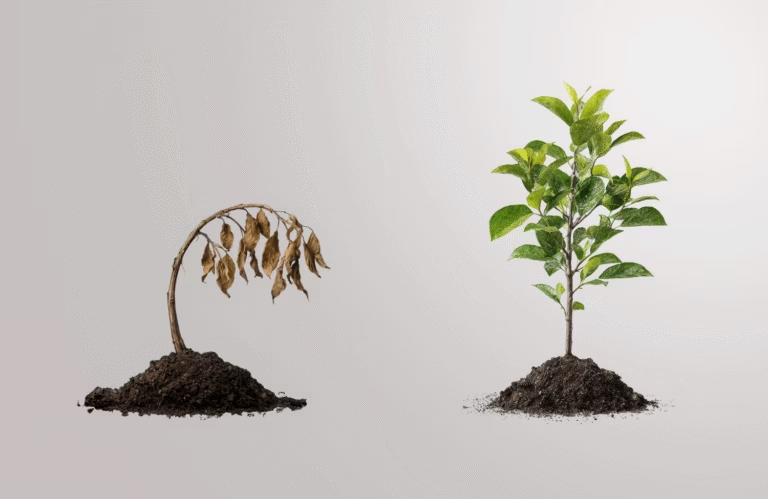
Africa’s agricultural challenge is stark. With 75-80% of cultivated land degraded, African soils lose 30-60 kg of vital nutrients per hectare annually, threatening food security for over 485 million people. Since the 2006 Abuja Declaration, fertilizer consumption increased only from 8 kg to 22 kg per hectare less than half the original target and far below the global average of 135 kg/ha. Decades of nutrient mining without replenishment have left African soils among the poorest globally.
Summit Objectives: “Listen to the Land”
Convened under the theme “Listen to the Land,” the summit had four strategic objectives:
- Emphasizing soil health’s critical role in sustainable agricultural productivity
- Developing a 10-year Action Plan with concrete, implementable recommendations
- Establishing the Soil Initiative for Africa to coordinate efforts and avoid duplication
- Creating financing mechanisms to ensure adequate funding for implementation—addressing the failure of past declarations
The Nairobi Declaration: Key Commitments by 2034
The 2006 Abuja Declaration focused primarily on fertilizer access but Nairobi proposes diverse, integrated approaches. The declaration’s thirteen transformative commitments include:
Production & Access
- Triple domestic production of certified organic and inorganic fertilizers
- Ensure 70% of smallholder farmers access targeted agronomic recommendations
- Support natural gas-producing states in fertilizer production for price stability
Financing & Infrastructure
- Fully operationalize the Africa Fertilizer Financing Mechanism (AFFM) through the African Development Bank
- Create a dedicated soil health fund under AFFM
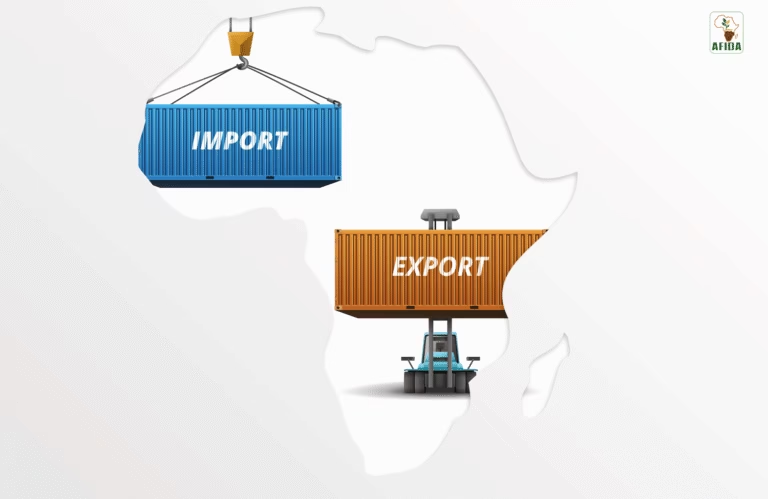
- Double intra-African fertilizer trade using the African Continental Free Trade Area
Sustainability & Knowledge
- Reverse land degradation on 30% of degraded soils through integrated management
- Provide 70% of farmers access to quality extension services
- Establish a continental digital soil information system for decision-making
Policy & Implementation
- Harmonize fertilizer standards and create enabling policy environments
- Integrate commitments into National Agricultural Investment Plans
- Direct Finance Ministers to allocate adequate resources
- African Union Commission to mobilize financial and technical resources from climate funds and partners
Fiscal Outcomes and Financing Architecture
The summit established a robust financial framework, representing a significant shift from traditional aid to sustainable financing:
The Africa Fertilizer Financing Mechanism 2.0 – Hosted by the African Development Bank, AFFM 2.0 will provide innovative financing products to ensure timely access to quality, affordable fertilizers, de-risk farmer investments, and support policy reforms. The mechanism will mobilize resources from multilateral development banks, bilateral donors, and private sector partners.
Development Partner Commitment – Fourteen development partners signed a joint statement supporting implementation, with the EU, DeSIRA Lift, and IFAD leading integrated soil health initiatives.
Multi-Stakeholder Investment Model – The declaration calls for partnerships combining public sector investment, private capital, climate finance, and development support—recognizing that no single funding source can address the challenge’s scale.
Implications for Public Sector Stakeholders
National Governments face four critical imperatives:
- Policy reform to harmonize fertilizer regulations, subsidy programs, and quality standards
- Budget allocation demonstrating how soil health investments contribute to economic development and climate resilience
- Extension service transformation to achieve 70% coverage through digital platforms and public-private partnerships
- Integration with CAADP by incorporating soil health into National Agricultural Investment Plans
African Union and Regional Bodies must deliver on:
- Robust monitoring and evaluation frameworks to track 2034 targets
- Active resource mobilization from climate funds and development partners
- Continental soil information systems and knowledge transfer platforms
Research Institutions have opportunities to develop context-specific solutions for diverse agro-ecological zones, precision agriculture tools, and organic fertilizer innovations tailored to African conditions.
Implications for Private Sector Stakeholders
Fertilizer Manufacturers and Distributors benefit from:
- Massive market opportunity in tripling domestic production
- Policy support for companies utilizing Africa’s natural gas resources
- Protection through quality certification standards against substandard competition
- Need for innovative last-mile distribution models to reach rural smallholders
Technology Providers can capitalize on:
- Enormous demand for digital advisory platforms serving the 70% target
- Soil testing, mapping, and data services for the continental information system
- Precision agriculture tools and mobile-based extension services
Agricultural Input Companies should focus on:
- Integrated solution packages combining seeds, fertilizers, and agronomic advice
- Input credit, crop insurance, and risk management services to drive adoption
Public-Private Partnership Opportunities span:
- Production facilities, storage, and distribution infrastructure
- Technology transfer and capacity building programs
- Research and development of context-specific solutions
- Innovative financing mechanisms sharing risk between sectors
Critical Implementation Challenges
The Implementation Gap – Past declarations fell short despite good intentions. As Bruce Kisitu of iSDA notes, “Implementing public sector commitments in most African countries takes significant time, and financing continues to be a challenge.” The question is whether AFFM and integrated investment plans can overcome historical failures.
Avoiding Duplication – Success requires genuine coordination and building on existing infrastructure like iSDA’s 30-meter resolution soil maps, rather than creating parallel structures.
Science-to-Action Translation – Critics note the need for “concrete and site-specific action plans with detailed roadmaps” and better dialogue between scientists and policymakers to close the gap between commitments and on-ground implementation.
A Defining Moment for African Agriculture
The Nairobi Declaration represents a fundamental shift—from simply increasing fertilizer use to integrated, sustainable approaches emphasizing soil health, precision agriculture, and local production. For public stakeholders, this demands reimagined policies and investment priorities. For private players, it signals growing markets with government support but heightened expectations around sustainability and smallholder inclusion.
Success depends on sustained political will, adequate financing, effective coordination, and genuine multi-stakeholder collaboration. With Africa’s population projected to double by 2050 and climate change intensifying challenges, soil health is fundamental to the continent’s food security, economic development, and climate resilience. The Nairobi Declaration offers a roadmap. The next decade will reveal whether Africa can truly “listen to the land” and deliver the transformative action its agricultural future demands.