
Africa’s agricultural transformation depends heavily on understanding the realities of fertilizer use on the continent. Let’s separate misconceptions from evidence-based facts.
MYTH #1: Organic farming alone can feed Africa without inorganic fertilizers
FACT: While organic practices are valuable for soil health, most experts agree that meeting Africa’s food security needs requires integrated approaches combining organic matter management with judicious use of inorganic fertilizers. The Montpellier Panel of agricultural experts emphasizes that sustainable intensification, not choosing between organic or conventional, but merging both is the path forward.
Traditional composting and crop rotation practices should be enhanced with targeted fertilizer use based on soil testing and crop requirements.
Source: Nature Sustainability Journal
MYTH #2: Fertilizer use automatically leads to higher yields and food security
FACT: Fertilizer application must be accompanied by proper soil management, appropriate seed varieties, and adequate water to be effective. Research from the International Food Policy Research Institute (IFPRI) shows that integrated soil fertility management (ISFM), combining organic and inorganic fertilizers with improved agronomic practices, delivers better results than fertilizer alone.
The Food and Agriculture Organization (FAO) emphasizes that soil health testing and precision agriculture approaches are crucial for maximizing fertilizer efficiency and preventing environmental degradation.
Source: FAO – Sustainable Soil Management
MYTH #3: Increasing fertilizer subsidies is the best solution for African agriculture
FACT: While subsidies can improve short-term access, evidence shows mixed long-term results. Research published in Nature and by the International Fertilizer Development Center (IFDC) indicates that poorly designed subsidy programs can distort markets, create dependency, and drain government budgets without building sustainable agricultural systems.
More effective approaches include strengthening private-sector fertilizer markets, improving rural infrastructure, developing local production capacity, and providing farmers with education on optimal application rates.
Source: IFDC – Fertilizer Market Development
MYTH #4: Climate change makes fertilizer use pointless in Africa
FACT: Climate change actually increases the importance of strategic fertilizer use. According to CGIAR’s Climate Change, Agriculture and Food Security (CCAFS) program, climate-smart agriculture practices that include appropriate fertilizer application help crops withstand drought stress and temperature variability.
Research shows that well-nourished plants with adequate nutrients demonstrate greater resilience to climate shocks. However, fertilizer strategies must be adapted to changing rainfall patterns and temperature regimes, making soil testing and weather-informed application timing even more critical.
Source: CCAFS – Climate-Smart Agriculture
MYTH #5: All African soils are the same and need the same fertilizer treatments
FACT: Africa has extraordinary soil diversity, from volcanic soils in the Rift Valley to sandy soils in the Sahel. The African Soil Information Service (AfSIS) has documented vast variations in soil pH, nutrient content, and organic matter across the continent.
Blanket fertilizer recommendations are ineffective and wasteful. Precision agriculture technologies and soil mapping initiatives are helping farmers apply the right nutrients in the right amounts for their specific conditions.
Source: CIMMYT – Soil Health in Africa
MYTH #6: Chemical fertilizers destroy soil health
FACT: When used appropriately with good management practices, synthetic fertilizers do not inherently destroy soil health. However, overuse or imbalanced application can lead to soil acidification, nutrient imbalances, and reduced organic matter.
Research from Cornell University’s College of Agriculture and Life Sciences shows that combining organic amendments with synthetic fertilizers maintains soil structure while providing essential nutrients. The key is balance and proper management.
Source: Science Direct – Agricultural Systems
MYTH #7: Africa does not produce enough fertilizer for its own needs
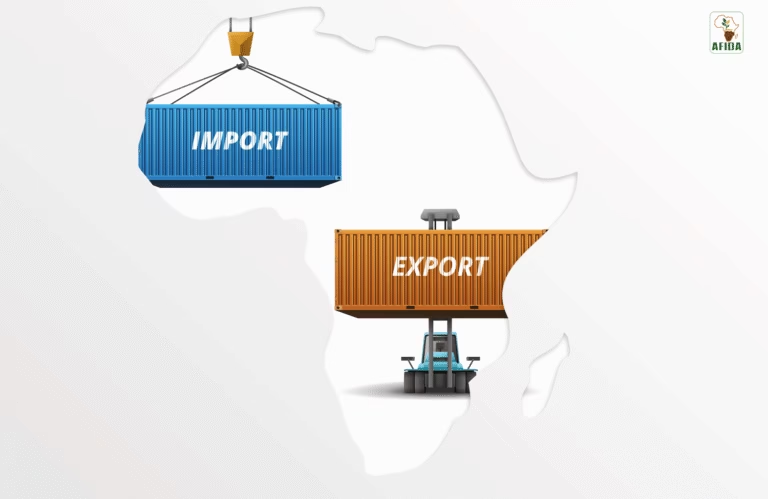
FACT: Africa as a continent produces more fertilizer than it consumes, driven largely by major exporters like Morocco, Nigeria, Egypt, Algeria, and South Africa, but a significant share of this production is exported rather than used locally. As a result, many Sub-Saharan African countries still import 80–90% of the fertilizer they consume due to limited processing capacity, high energy costs, and infrastructure constraints. Closing this gap will require targeted investment in regional manufacturing, energy access, and intra-African supply chains.
Sources: International Fertilizer Development Center (IFDC) – Africa Fertilizer Markets
MYTH #8: Digital agriculture and precision farming aren’t relevant for smallholder African farmers
FACT: Mobile technology and digital platforms are revolutionizing fertilizer access and use across Africa. Companies like Farmcrowdy, Farmerline, and WeFarm provide smallholders with information on optimal fertilizer use, soil testing, and market access through basic mobile phones.
The GSMA AgriTech initiative documents how digital solutions are helping farmers make informed decisions about fertilizer purchases and application.
Source: GSMA – Mobile for Development
The Path Forward
Improving fertilizer use in Africa requires a nuanced approach that addresses affordability, education, soil health, market development, and technology adoption simultaneously. Understanding these facts helps stakeholders, from policymakers to ag-tech innovators, develop evidence-based solutions for sustainable agricultural transformation.