

Fertilizer use in Africa is widely misunderstood, with persistent myths masking evidence-based solutions to food security challenges. Although application rates in sub-Saharan Africa remain low at about 15–20 kg/ha compared to the global average of 135 kg/ha, the barriers go far beyond farmer awareness and include gender inequality, quality of inputs, climate pressures, and limited market access. Sustainable agricultural transformation depends on integrated approaches that address the technical, social, economic, and environmental dimensions of fertilizer use across diverse farming systems.
MYTH #9: Women farmers in Africa have equal access to fertilizer
FACT: Significant gender disparities exist in fertilizer access across Africa. The UN Food and Agriculture Organization (FAO) reports that women farmers who produce 60-80% of food in sub-Saharan Africa face greater barriers to accessing fertilizer due to limited land rights, reduced access to credit, and exclusion from farmer cooperatives.
Studies from IFPRI show that closing the gender gap in agricultural inputs, including fertilizer, could increase yields on women’s farms by 20-30% and reduce hunger for 150 million people.
Source: FAO – Gender and Land Rights
MYTH #10: Nitrogen fertilizers are the only nutrients African soils need
FACT: While nitrogen deficiency is common, African soils often suffer from multiple nutrient deficiencies, particularly phosphorus, potassium, sulfur, and micronutrients like zinc and boron. Research from CABI (Centre for Agriculture and Bioscience International) demonstrates that balanced fertilization addressing multiple nutrients yields significantly better results than applying any one nutrient.
The African Soil Health Consortium emphasizes that many African soils are phosphorus-deficient, and applying nitrogen without phosphorus can actually reduce yields.
Source: CABI – Plantwise Knowledge Bank
MYTH #11: Poor quality fertilizer isn’t a significant problem in Africa
FACT: Substandard fertilizers represent a major challenge, with estimates suggesting 30-40% of fertilizer in some markets may be adulterated or fake. According to IFDC investigations, farmers often pay full price for products with reduced nutrient content or fillers, leading to poor yields and distrust of fertilizer.
Quality assurance systems, regulatory enforcement, and farmer education on identifying genuine products are critical needs. Some countries like Nigeria and Kenya have implemented fertilizer authentication systems using mobile verification codes.
Source: IFDC – Fertilizer Quality Control
MYTH #12: Large-scale commercial farms are the primary fertilizer users in Africa
FACT: While commercial farms use fertilizer more intensively, smallholder farmers collectively represent the largest potential market. The African Union’s Comprehensive Africa Agriculture Development Programme (CAADP) notes that smallholders farm approximately 80% of agricultural land in sub-Saharan Africa.
However, smallholders face unique challenges including limited access to bulk purchasing, lack of storage facilities, and inability to access credit for input purchases. Innovative financing models and aggregation platforms are emerging to serve this market segment.
Source: NEPAD – CAADP
MYTH #13: Traditional African farming practices are incompatible with modern fertilizer use
FACT: Indigenous knowledge and modern inputs are highly complementary. Research from World Agroforestry (ICRAF) shows that traditional practices like intercropping with nitrogen-fixing legumes, agroforestry, and crop rotation enhance fertilizer efficiency and reduce the amounts needed.
The concept of “fertilizer trees” (like Faidherbia albida) that fix nitrogen and provide organic matter demonstrates how traditional and modern approaches can work synergistically. Integrated soil fertility management builds on farmers’ existing knowledge while adding precision inputs.
Source: World Agroforestry Centre
MYTH #14: Fertilizer contamination is destroying Africa’s water systems
FACT: While fertilizer runoff is a concern globally, current usage rates in most of Africa are far below levels that cause widespread eutrophication. The Stockholm Environment Institute notes that with application rates of 15-20 kg/ha, most African agricultural systems are nutrient-depleted rather than nutrient-saturated.
However, as fertilizer use increases, proactive environmental management is essential. Best management practices including proper timing, placement, and rates can minimize environmental impacts while still achieving productivity goals.
Source: Stockholm Environment Institute – Agriculture and Water
MYTH #15: Youth aren’t interested in fertilizer and agricultural input businesses
FACT: Agricultural entrepreneurship, including fertilizer retail and agri-input businesses, is attracting significant youth interest across Africa. Organizations like YouthAgriPreneur and the Mastercard Foundation’s Young Africa Works strategy report growing numbers of young entrepreneurs in agricultural input supply chains.
Digital platforms, franchising models, and social enterprises are making fertilizer distribution more attractive and profitable for young business owners, particularly in last-mile distribution.
Source: Mastercard Foundation
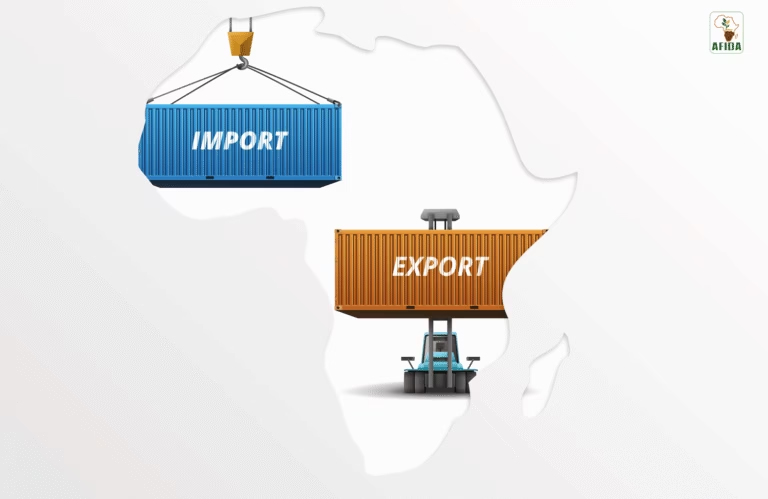
MYTH #16: All fertilizer must be imported from outside Africa
FACT: Africa has substantial capacity for regional fertilizer production and trade. Morocco is the world’s leading phosphate exporter, Nigeria has significant urea production capacity, and countries like Egypt, Algeria, and South Africa have established fertilizer industries. Many other countries in Africa have natural resources that are suitable for fertilizer production in varying quantities.
According to the African Fertilizer and Agribusiness Partnership (AFAP), intra-African fertilizer trade is growing, though infrastructure challenges and trade barriers still limit regional market integration. The African Continental Free Trade Area (AfCFTA) offers opportunities to enhance regional fertilizer markets.
Source: African Union – AfCFTA
MYTH #17: Fertilizer recommendations from extension services are always reliable
FACT: While extension services provide valuable guidance, blanket recommendations often don’t account for local soil variability. Research from CIMMYT shows that fertilizer recommendations should be based on actual soil tests rather than general regional guidelines.
The gap between generic advice and site-specific needs has led to innovations in soil testing services, including mobile soil labs and remote sensing technologies that provide farmers with customized fertilizer recommendations.
Source: CIMMYT – Precision Agriculture
MYTH #18: Organic alternatives can completely replace synthetic fertilizers at current productivity needs
FACT: While organic inputs are crucial for soil health, producing sufficient compost or manure to meet crop nutrient needs at scale presents significant challenges. The International Institute of Tropical Agriculture (IITA) calculates that achieving recommended nutrient levels through organic sources alone would require 5-10 tons of compost per hectare annually, often more than smallholders can produce or transport.
The most sustainable and practical approach combines organic matter for soil structure and biology with targeted synthetic fertilizers for specific nutrient needs—an approach called Integrated Soil Fertility Management (ISFM).
Source: IITA – Integrated Soil Fertility Management
MYTH #19: Fertilizer education programs don’t work with low-literacy farmers
FACT: Innovative visual, audio, and demonstration-based education methods have proven highly effective. Organizations like Digital Green use participatory video, while Farm Radio International reaches millions through radio programs in local languages.
Farmer field schools, demonstration plots, and peer-to-peer learning have shown remarkable success in improving fertilizer knowledge and application practices, regardless of formal education levels. Mobile apps with voice interfaces and pictorial guides are also expanding access to fertilizer information.
Source: Farm Radio International
Looking Ahead
These additional myths and facts highlight the complexity of fertilizer use in African agriculture. Success requires addressing interconnected challenges: gender equity, quality control, environmental sustainability, knowledge transfer, market development, and technological innovation. Evidence-based approaches that respect local context while leveraging modern tools offer the most promising path toward agricultural transformation.