
How Africa’s Continental Free Trade Area Is Reshaping Agriculture for Producers, Distributors, and Farmers
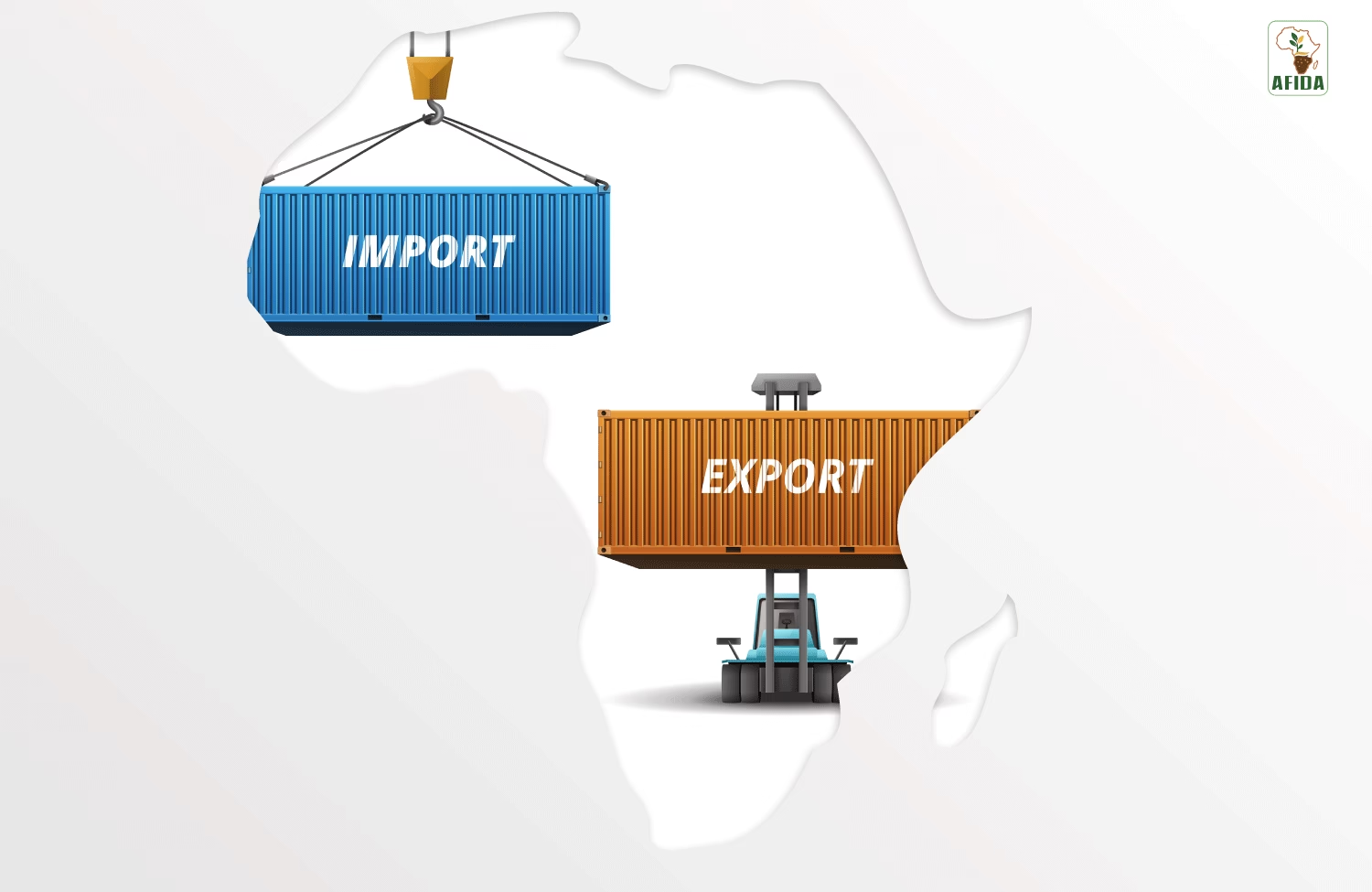
Africa stands at an extraordinary agricultural crossroads. With over 60% of the world’s uncultivated arable land and a population set to surpass 2.5 billion by 2050, the continent has the raw ingredients for a food production revolution. Yet for decades, one stubborn bottleneck has constrained growth: the fragmented, tariff-heavy intra-African trade environment that made it cheaper and easier to import fertilizer from Rotterdam than from a neighboring country. The African Continental Free Trade Area (AfCFTA) is changing that calculus, and nowhere is the impact more immediately felt than in the fertilizer sector.
What Is AfCFTA, and Why Does It Matter for Agriculture?
Launched in 2021 and now operational across 54 of 55 African Union member states, the AfCFTA is the world’s largest free trade area by number of participating countries. Its goals are ambitious: eliminate tariffs on 90% of goods, reduce non-tariff barriers, harmonize trade regulations, and ultimately forge a single market of 1.7 billion consumers with a combined GDP exceeding $3.4 trillion. For the agriculture sector, which contributes 35% of Africa’s GDP and employs more than half its workforce, the agreement promises nothing less than a structural transformation.
As the World Economic Forum notes, the AfCFTA food and agriculture market alone has the potential to grow from $280 billion annually (2023) to $1 trillion by 2030, but only if African countries can trade efficiently with each other. That requires a functioning, affordable fertilizer supply chain.
Africa’s Fertilizer Challenge: The Numbers Tell the Story
Africa’s fertilizer use gap is stark. On average, African farmers apply less than 26 kg of fertilizer per hectare, a fraction of the 140–200 kg per hectare common in Asia and Latin America. This isn’t primarily a knowledge problem. It is an access, affordability, and supply chain problem.
Key challenges include:
Fragmented markets: 54 separate regulatory environments mean importers must navigate dozens of standards, certifications, and duty structures.
Import dependency: Africa imports approximately $50 billion worth of agricultural products annually, with fertilizer making up a substantial share, and most of it sourced from outside the continent.
Infrastructure gaps: Poor road connectivity, port congestion, and limited storage hamper distribution, particularly to landlocked markets like Burkina Faso, Mali, and Rwanda.
Price volatility: The Russia-Ukraine war exposed Africa’s dangerous dependency on external fertilizer suppliers, sending prices soaring and threatening food security across the continent.
The UN Economic Commission for Africa’s ERA 2025 report is unambiguous: a full AfCFTA implementation by 2045 could increase intra-African trade by $276 billion (+45%) and boost continental GDP by $141 billion. Critically, the fertilizer sector is explicitly identified as one that can use the AfCFTA to pivot toward regional markets in response to global tariff pressures.
What AfCFTA Means for Fertilizer Producers
For fertilizer manufacturers operating on the continent, including large-scale producers including blenders in Morocco, Nigeria, Egypt, Algeria, Tunisia, South Africa, Tanzania, Zimbabwe, and Zambia, AfCFTA presents a transformational market opportunity. Where previously a Moroccan producer faced tariffs and bureaucratic friction selling into Côte d’Ivoire or Kenya, a harmonised trade framework eliminates those walls.
According to WEF analysis, new agricultural activity under AfCFTA is expected to require an 800% increase in fertilizer application for main nutrients, a staggering demand signal for any supplier. By 2030, intra-African agricultural trade is projected to increase by 574% if import tariffs are eliminated, with fertilizer flowing as a critical enabler of that growth.
Opportunities for Distributors and Agri-Logistics Operators
The fertilizer distribution layer, importers, blenders, warehouse operators, and last-mile delivery networks stand to benefit enormously from AfCFTA. Regional ports such as Lomé (Togo), Abidjan (Côte d’Ivoire), and Dar es Salaam (Tanzania) are already evolving into continental fertilizer hubs, supporting trade flows into landlocked markets. Under AfCFTA, the economics of operating these corridors improve dramatically as tariffs fall and transit procedures are streamlined.
A particularly significant development is the African Trade Exchange Platform (ATEX), a digital B2B and B2G exchange established by Afreximbank in collaboration with the African Union Commission and the AfCFTA Secretariat. ATEX supports bulk procurement of commodities, including fertilizers, connecting verified suppliers with buyers across the continent at transparent, competitive prices. For distributors, this platform reduces the information asymmetries and contract risks that have historically made intra-African fertilizer trade more expensive than extra-African sourcing.
How AfCFTA Benefits Farmers, Especially Smallholders
At the end of the fertilizer value chain is the farmer, and for the 60–70% of African farmers who operate smallholder plots of fewer than two hectares, fertilizer affordability, amongst many other important factors, is one of the differences between subsistence and surplus. AfCFTA addresses this through two pathways: lower input prices via tariff elimination, and a larger export market that makes it economically worthwhile for farmers to invest in productivity-enhancing inputs.
The 2025 Africa Agriculture Trade Monitor (AATM) highlights that intra-African agricultural trade has already tripled between 2003 and 2023, a powerful proof of concept before AfCFTA’s full tariff schedule is implemented. The report explicitly calls for policies prioritizing regional self-sufficiency within the AfCFTA framework, with fertilizer trade identified as a key lever for food security.
The African Fertilizer and Agribusiness Partnership (AFAP) represents the type of institutional actor that AfCFTA empowers. By working across governments, the private sector, and international organizations to increase market access for agri-SMEs, AFAP’s model scales precisely when the trade environment removes cross-border friction, which is exactly what AfCFTA is designed to do.
The Road Ahead: Key Conditions for Success
AfCFTA’s promise is real, but so are the preconditions for that promise to materialize. The African Union’s Fertilizer and Soil Health Action Plan 2024–2034 outlines the complementary investments required: enhanced soil and fertilizer laboratory networks, regional knowledge exchange systems, harmonized regulatory standards, and last-mile delivery innovations to reach remote smallholders.
Three priority actions stand out:
Regulatory harmonization: Divergent national fertilizer standards remain a major non-tariff barrier. AfCFTA’s success depends on member states aligning certification requirements so that a fertilizer approved in Nigeria can move freely into Ghana or Senegal.
Infrastructure investment: Tariff elimination is only effective if physical goods can move. An estimated $8 billion in storage investment and $65 million in irrigation infrastructure will be needed to support the agricultural expansion AfCFTA enables.
Digital trade facilitation: Tools like ATEX and blockchain-based customs systems are critical for reducing the transaction costs that have historically made intra-African trade uncompetitive.
Conclusion: A Window of Opportunity That’s Open Right Now
AfCFTA is not a distant aspiration. It is an operational agreement with a live tariff reduction schedule. For fertilizer producers, the continent is opening a market that could require 800% more fertilizer application by the time AfCFTA is fully implemented. For distributors, regional corridors and digital platforms are already enabling more efficient trade flows. For farmers, lower input costs and expanded export markets are the tangible dividends of deeper integration.
Africa’s fertilizer demand is projected to grow by 5–7% annually through 2030, and that is the conservative estimate before AfCFTA’s full tariff schedule kicks in. The businesses and policymakers who recognise that intra-African trade is not a second-best option but a strategic imperative will be best placed to capture the extraordinary value that this continental market is set to unlock.
The question for fertilizer value chain actors across Africa is no longer whether AfCFTA matters. It is how we are ready to move with it.